
What should we be drafting for?
Texas Hill Country, Thanksgiving Turkey, and the NBA Draft

The NBA Draft is tomorrow. It seems that everyone is getting off their final takes and pushing their final big boards, so I figured I should probably join in on the noise. I’m certainly not a draft guy. At least not an internet draft guy. It generally seems like a pretty scary place. There’s a lot of arguing and a lot of posturing to make sure that when you go to quote-tweet yourself in three years that you look like you had the smartest take. Don’t get me wrong, I spend hours on draft Twitter scrolling through big boards. The less context and hotter the take, the better.
But it’s all a pretty interesting way to approach what is a nearly impossible problem to solve. We’re projecting future basketball performance, which is pretty hard. And we’re projecting future basketball performance of young players, which is marginally harder. And we’re projecting the future basketball performance of young players in a league they’ve never played in.
And on top of that, we’re projecting future performance without always defining what that future target is. I get we’re trying to draft the best basketball player, but over what time horizon? And best in what way? Do we want the best player in expectation, or maybe the player with the best shot at being the best? And should we approach the draft trying to win each individual draft (i.e., select the best player), or should we approach the draft in, say, 5 year chunks and try to get the best return on that time period? Essentially, I’m not sure we’ve reached much of a consensus about what we’re drafting for. And I'm also not sure there is a consensus to be reached!
And so, I’ve generally been thinking about this year’s draft a step or two removed from the concreteness of ranking the prospects. I thought a bit about what truths outside of basketball might apply to basketball. In doing so, I came across this piece by DBCJason that touched on some of my thoughts and carried them forward in more concrete ways than I had. I’ll outline it below, but I promise it’s worth a full read.
What follows is an attempt to articulate a plausible draft philosophy and support it with a rough model.
How could they know about the grass?
Robert Caro is sort of my GOAT. For more reasons than I could put before turning this into a Robert Caro post. But in short, he’s been working on a biography of Lyndon Johnson since 1974. It’s currently four volumes deep with a fifth in progress. More than fifty years on one project. And as you might imagine, Caro gives this fifty-year work every ounce of attention and detail it deserves. His commitment both to the project and the process (in person detailed interviews, historical methods, and living in the places he writes about) rivals just about any other great story of excellence and longevity you can think of (Justo Gallego Martinez is another of my favorites worth learning more about).
The first chapter of The Path to Power, the first that Caro wrote about Lyndon B. Johnson, mentions the future president very little. Instead, Caro focuses on the late 19th-century settlers of the Texas Hill Country. These settlers were small farmers from the hill and forest sections of the South. They lived off the land. And so, when they left their depleted, barren soil of the South for a new start elsewhere, they looked for land that looked suitable for future growth. In the South, land with grass tended to be a good proxy for growing other stuff, and the Texas Hill Country was full of land with grass:
To these men the grass was proof that their dreams would come true. In country where grass grew like that, cotton would surely grow tall, and cattle fat—and men rich. In country where grass grew like that, they thought, anything would grow.
How could they know about the grass?
The Hill Country was, as Caro repeats throughout the chapter, a trap baited with grass.
The settlers did not know that the grass had grown over centuries, disturbed only by the occasional prairie fire, which killed the underbrush and cleared the way for even more grass. And it grew slowly. The Hill Country was also limestone country. The hardness of limestone makes it produce soil slowly. The settlers arrived without any context predating them.
As time went on, farmers did farmer stuff. They planted cotton. They let their cattle graze on the abundant grass. They used their steel-bladed plows not knowing they would be ripping the roots from the fragile soil between harvests, leaving the already fragile ground defenseless all winter.
And also as time went on, nature did nature stuff. Drought came, which, when paired with the Texas heat, dried out the crops. Then wind, which blew the dust all around. Then later rain, which washed away the thin layer of soil that remained.
It had taken centuries to create the richness of the Hill Country. In two decades or three after man came into it, the richness was gone. In the early 1870s, the first few years of cotton-planting there, an acre produced a bale or more of cotton; by 1890, it took more than three acres to product that bale; by 1900, it took eleven acres.
What once seemed like a prosperous new land quickly turned into quite the opposite. And it took quite a while for those in the Hill Country to recognize the trap. Many continued to move there, including the Johnson family, hoping to find prosperity. As a spoiler: they did not.
How could they know about the grass?
The parable of the turkey
The story of the Texas Hill Country reminded me of the example of the turkey, as told by Nassim Taleb in his book The Black Swan, which is adapted from Bertrand Russell’s story relating to a chicken, which is further adapted in a more amusing way in this article:
There was once a turkey who was hatched on a cold winter’s morning. Luckily, he lived with his family in a warm coop, where he had plenty of corn to eat, and spent his time playing with all the other little turkeys.
In springtime, as he got older, he and his friends would go out and play together in the farmyard. They always had plenty to eat and shelter from the elements. On occasion, nice people would come and clean the coop, refill the corn bins, and make sure the fences were secure to keep away the bad cats and foxes.
“Gosh we’re lucky,” our turkey would say to his friends on occasion. “What wonderful lives we have. We are fed and taken care of, and all we have to worry about is having fun.”
As the summer days got shorter and the evenings got colder, the turkeys continued to live the good life. The farmer turned on the heat in the coop, so the turkeys always had somewhere warm to go back to after playing in the yard. And since it was much colder now, they rarely went outside, and slowly they got fatter and fatter.
Our turkey continued to remark to his fellow fowl, “How lucky we are,” and they all agreed that they would rest up during the cold months so they could play hard again in the spring.
And then came Thanksgiving.
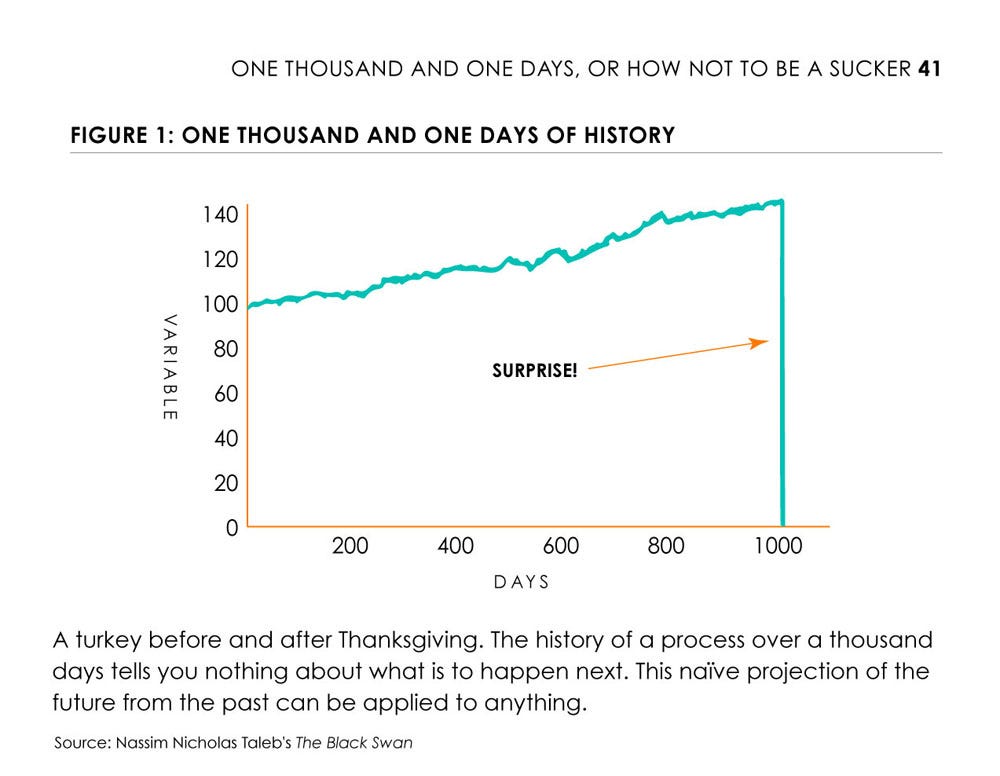
How could the turkey know about Thanksgiving?
The problem of induction
This is all a dressed-up version of the problem of induction: no number of past observations logically guarantees anything about the future.
Different fields have built different models for handling the problem of induction. Finance and insurance have probably thought about it longest and still probably don’t totally get it right. Value-at-risk models, credit ratings, and actuarial tables all assume the future will resemble the recent past, which works beautifully until it doesn't (see 2008). Other models, like those mentioned by Taleb and practiced by firms like Universa, stop trying to predict tail events and instead build portfolios that survive or profit from them. Reinsurance giants like Munich Re do something similar.
But in a field like engineering, at least in certain industries, you can’t just approach the problem trying to absorb the event. For example, imagine you build cars. You have a design defect where the fuel tank blows up every time the car was involved in a rear-end collision. Your answer to “what are you going to do about all of these cars catching on fire?” can’t be “we’ve priced in those lawsuits, so no biggie” (though, Ford sort of tried this in the 1970s with the Ford Pinto ordeal). And so, relatedly, when you’re building a car from the start, you can’t just diversify your way out of that rare catastrophic event tail risk.
What does this have to do with the NBA Draft?
I just longwindedly wanted to establish that there are many things we believe will be true about the future that are supported by the data we have available to us that end up being totally wrong. If you accept that the future doesn’t have to resemble the past, what does that mean for our approach to the NBA Draft? A few plausible thoughts:
We may discount analytical draft models. Certainly not a full discount, but a draft model is taking a bunch of data about a previous state of the world and applying it to a future state of the world.
We may discount the eye test. Largely for similar reasons, the eye test is just a skilled evaluator’s mental model of all players they’ve observed before, and taking that context to evaluate the future of the player at hand.
We may put a premium on the blind spot. If the draft model and the eye test both have some blind spots for the unprecedented, then there might be a mispricing there. So, relatively, we may then put a premium on prospects who are unprecedented in some way or don’t resemble the historical sample. Or at least avail ourselves of selecting them.
It’s worth pausing here to say: we shouldn’t ignore historical data. Draft models and scouting still do quite well, all things considered. A robust set of historical data is still our best path to predicting the future. Anyone with a model worth anything will tell you that there are gaps.
A Draft Philosophy
As mentioned above, DBCJason’s piece outlines a philosophy that, in my estimation, gets close to filling the above blind spot. In short, if we stop pattern-matching prospects to prior profiles and instead search for something new, there’s a potential surplus. Boiled down to three pillars:
Unique Production. The path of least resistance to being the best is to do something unique, uniquely well, or something unique uniquely well. If you can find a prospect with the ability to do one of these things, they are more likely to be the best.
Chase Upside. Most NBA players are replaceable. The value of impact is exponential. It’s hard to find the very best players, and relatively easier to find everyone else. So optimize your draft strategy to hunt for the most valuable pieces.
Reduce Variance. The best players suppress basketball’s inherent randomness. Some of the best ways to do this are (1) dominate the paint, which is the lowest-variance area of the floor, (2) create shots independent of (or less dependent on) the circumstance, and (3) increase possessions relative to the opponent.
Applying this Philosophy
Let’s explore each pillar in application to the 2026 Draft Class. I don’t have a great source of international prospect data, so I’m just using the collegiate prospects in 2026. I’m also using draft class data back to 2010, again only including college players.
Uniqueness
For every prospect, we can measure the distance to their nearest historical drafted players across their statistical profile. Those with the furthest distance away from comparison may be more likely to offer something unique. Here, I’m using a 43-factor profile, including a bunch of box stats, age, size, role, shot diet, and some play-by-play stats. I suppose this should really just be called dissimilarity.
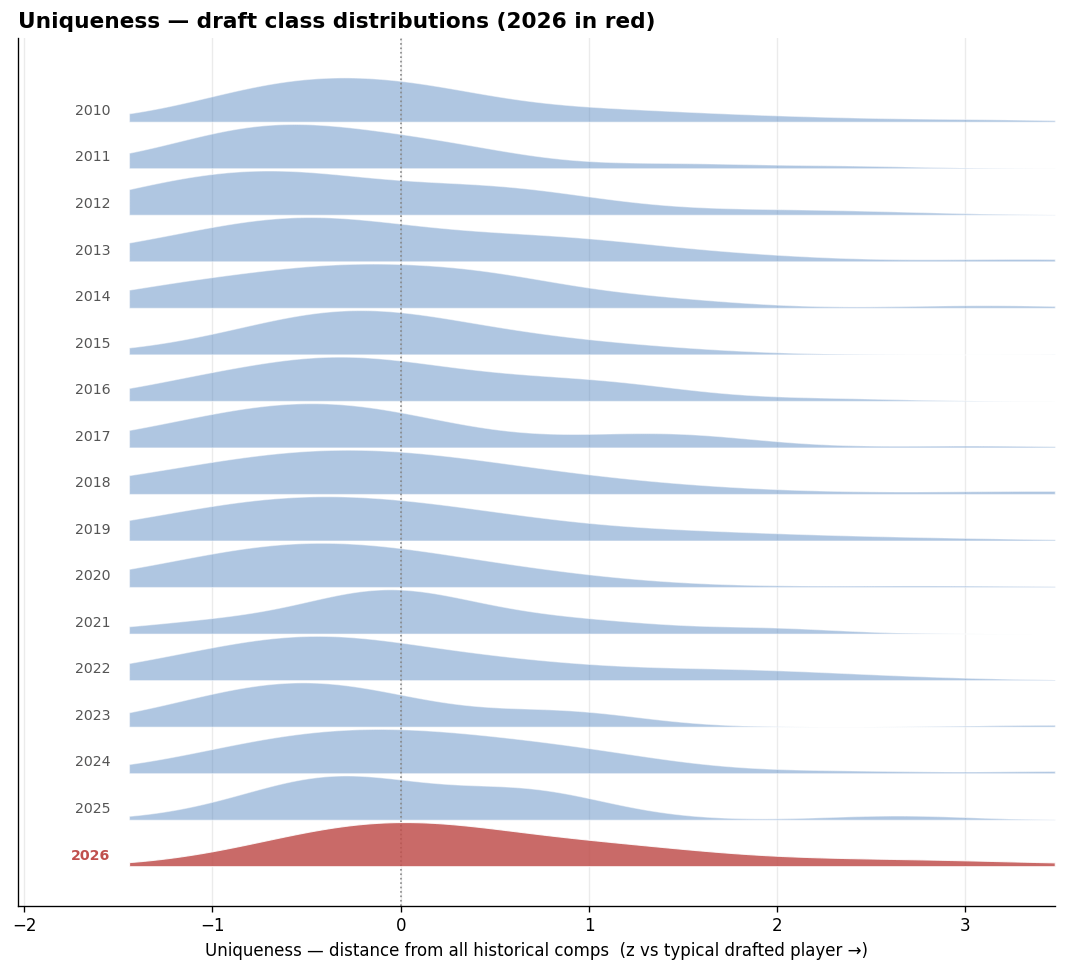
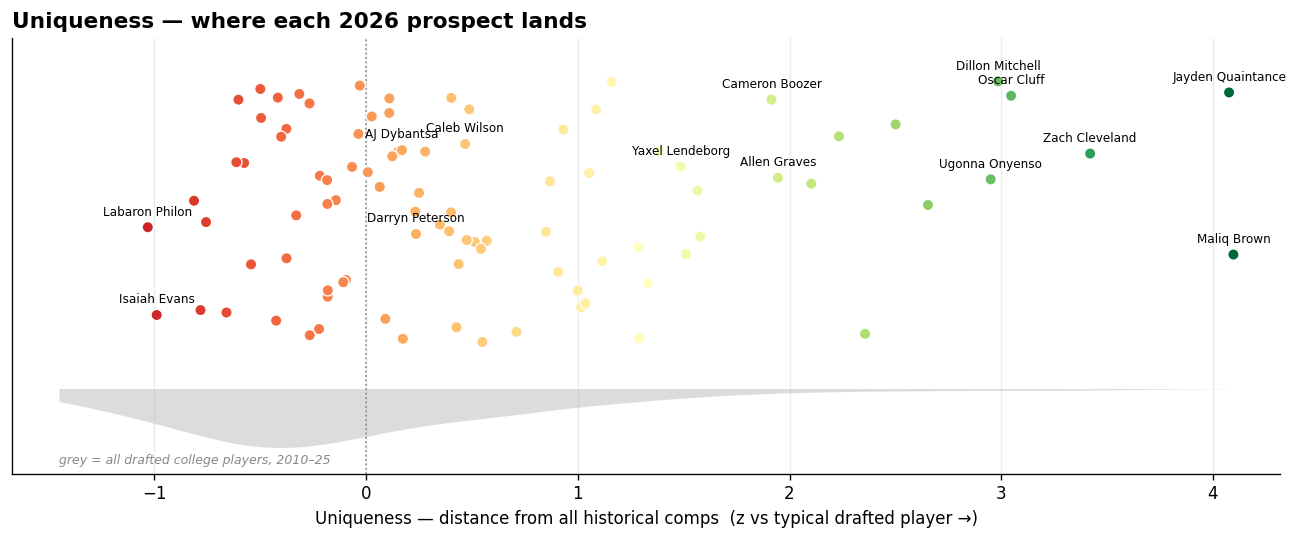
But uniqueness is just one piece of this puzzle.
Upside
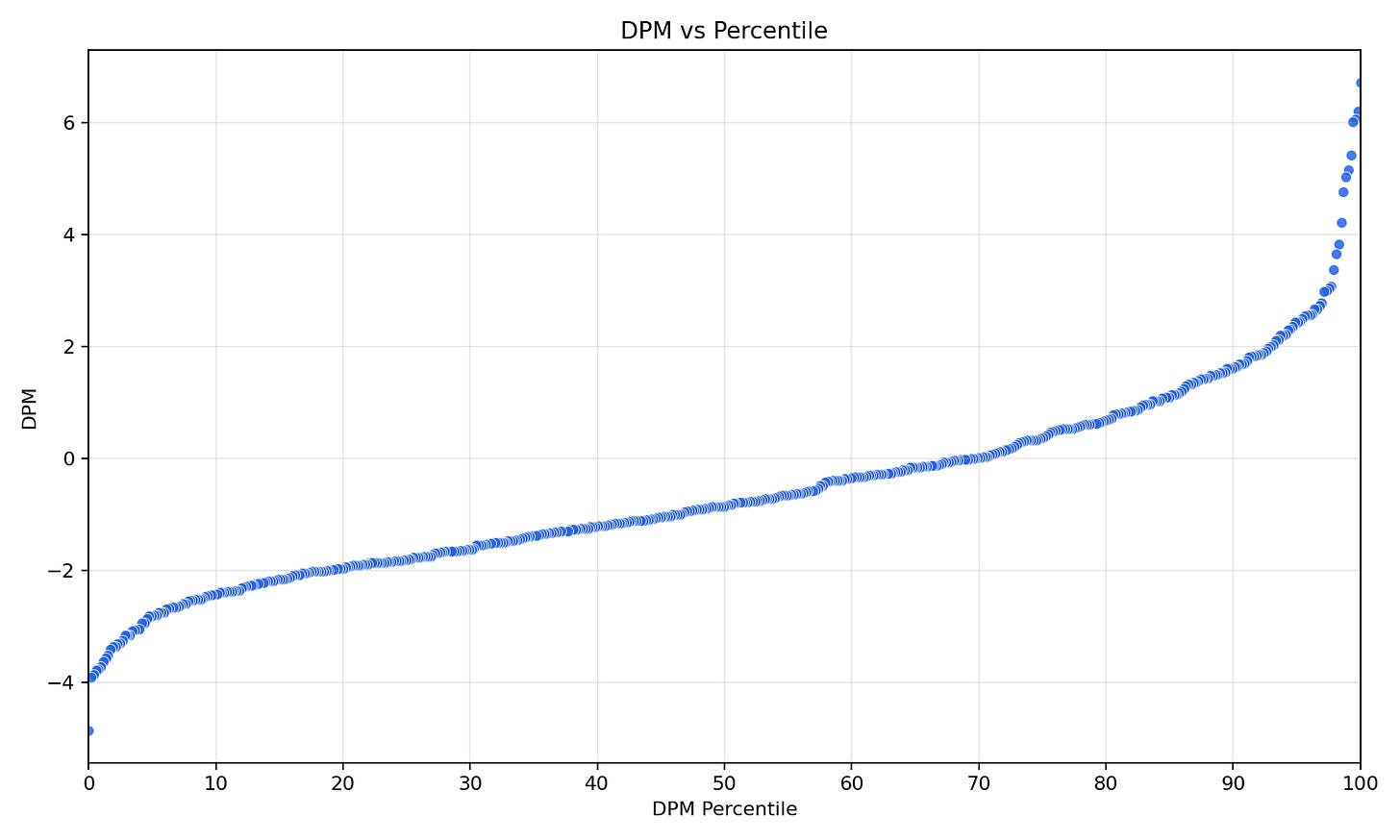
To explore upside, I put together a relatively simple EPM projection model. Others have published very well thought-out and detailed pieces about how to put together a draft model like this one, so I’ll spare much of the detail. In short, the model targets peak NBA impact (measured in EPM), building a distribution in two pieces: (1) will he reach rotation level in the league? and (2) if he does, how good will he be? Stacked best to worst, the top 40 of the 2026 class looks like this:
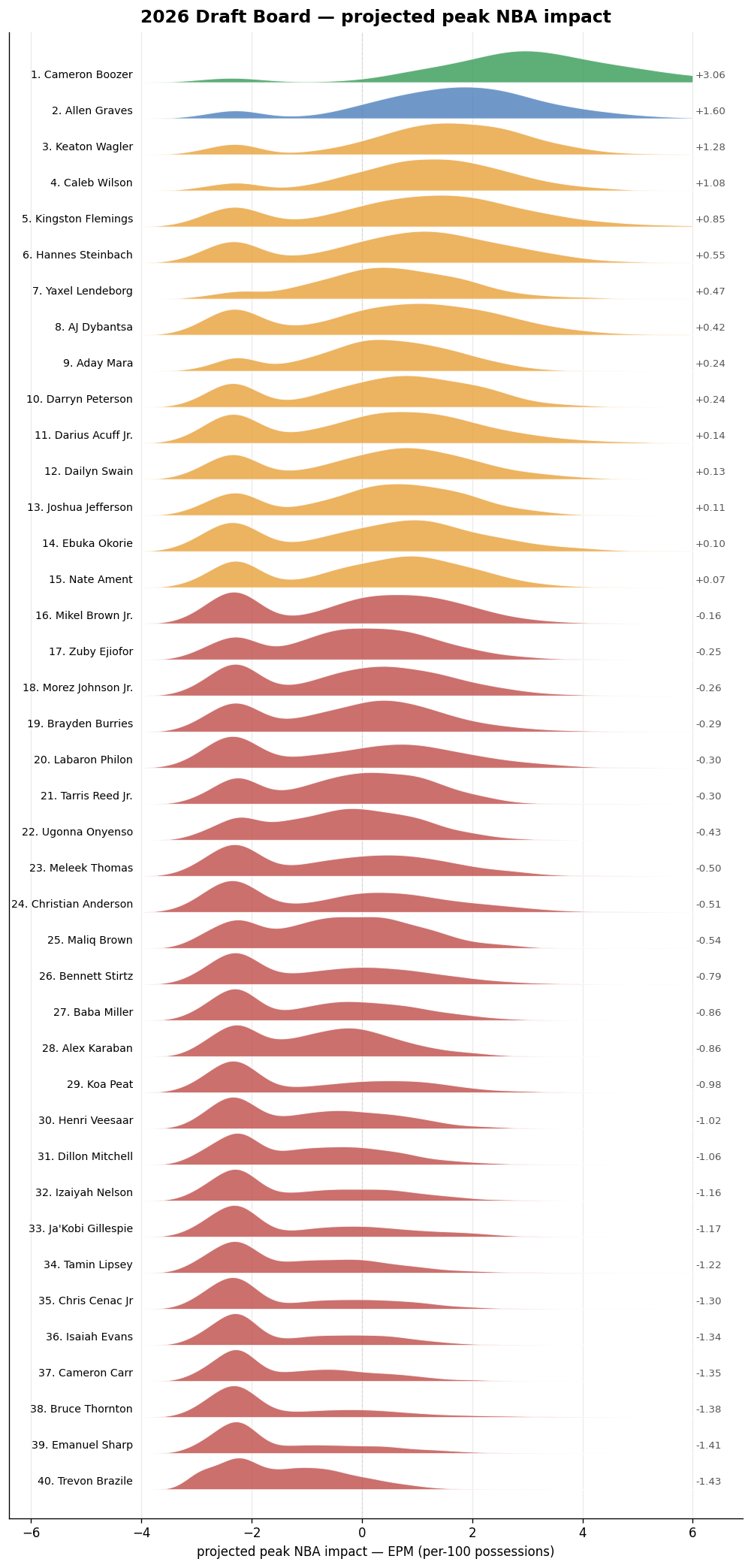
There is probably a good bit of feature engineering I could’ve done on this piece. I think it’s directionally correct, but also quite flawed. For purposes of exploring our philosophy here, I think it’s fine.
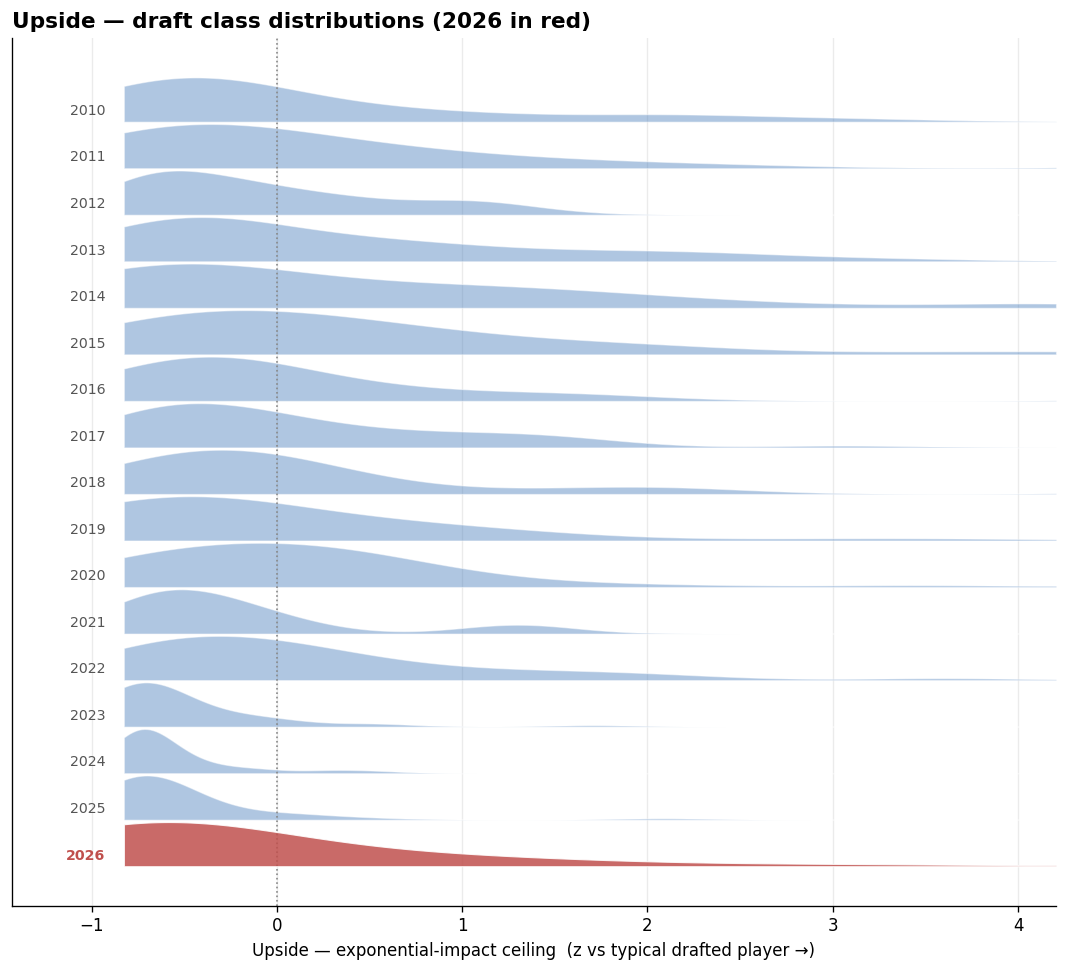
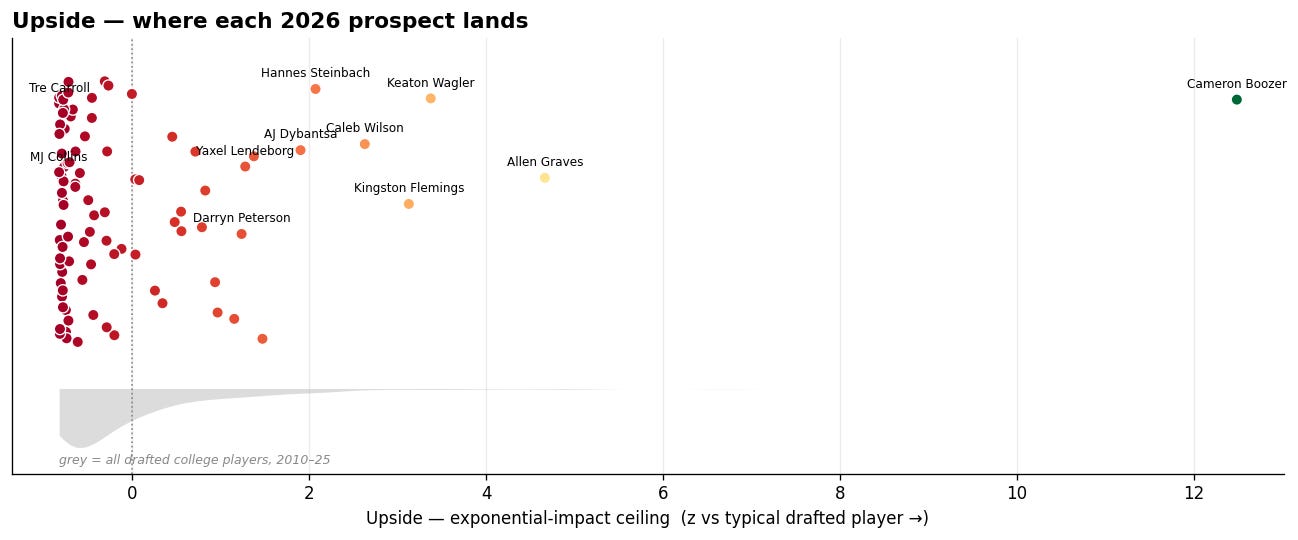
I particularly like it for visualizing the upside tail that we want to focus on. To determine upside, I threw out the replacement-level and below outcomes and weight what’s left by a convex curve so the star-level draws dominate. (upside = E[ max(peakEPM − (−2), 0)^3.0 ]).
Variance Reduction
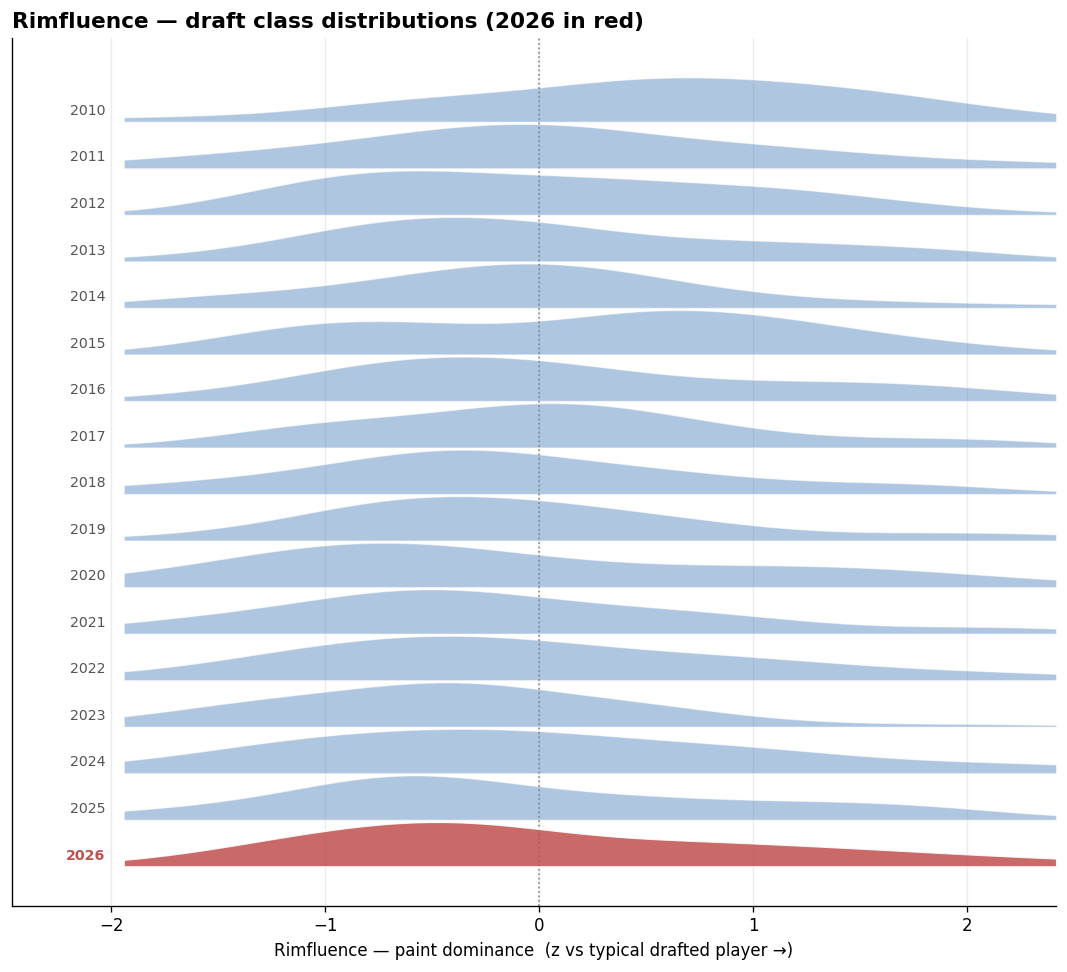
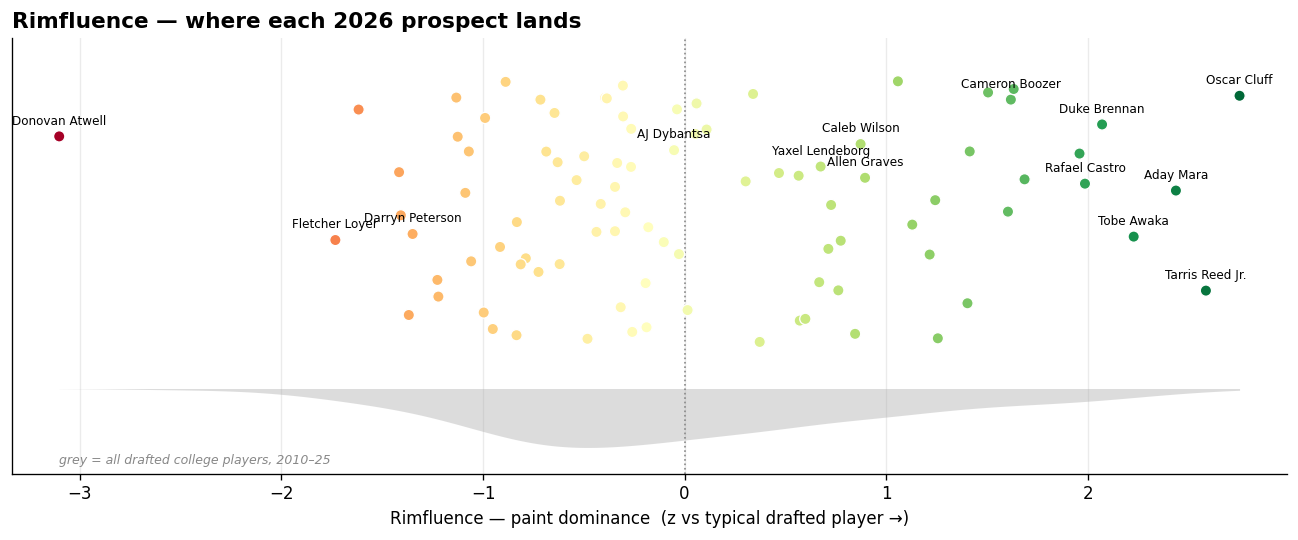
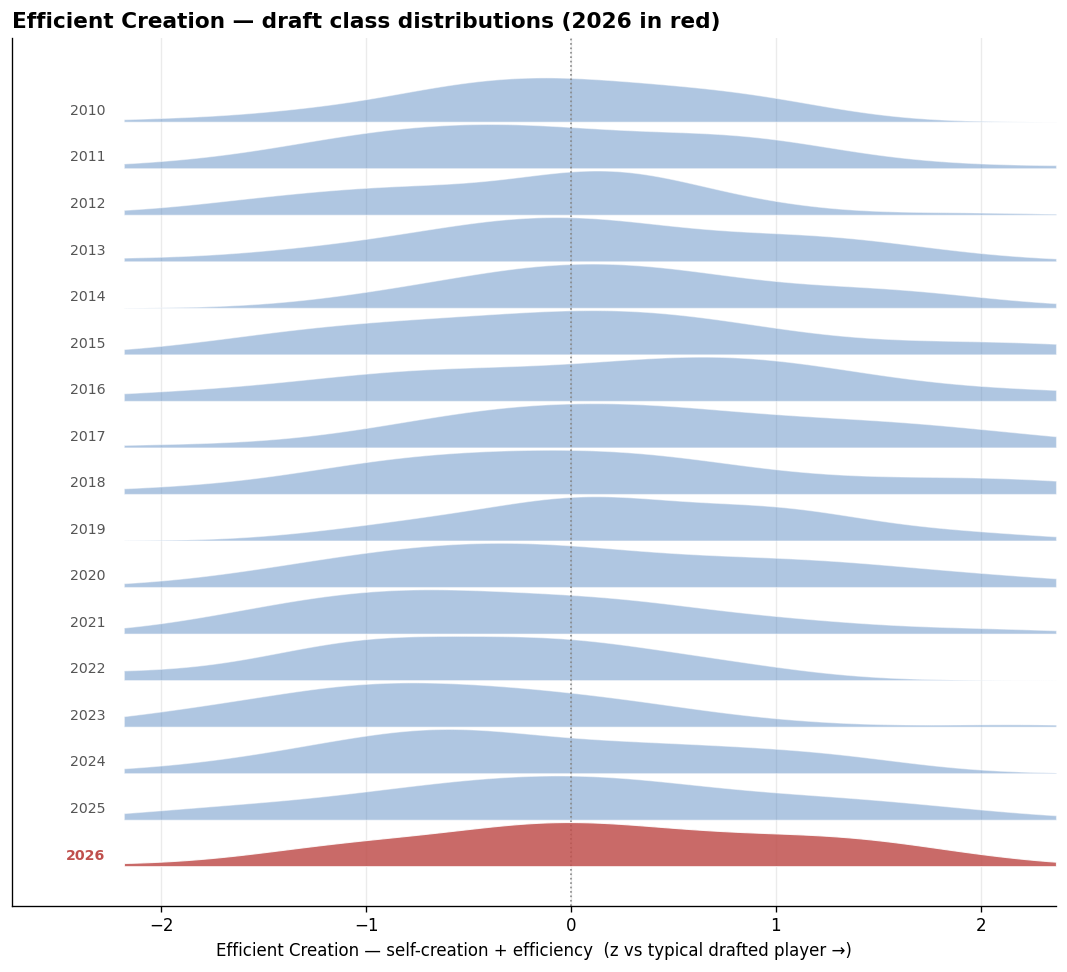
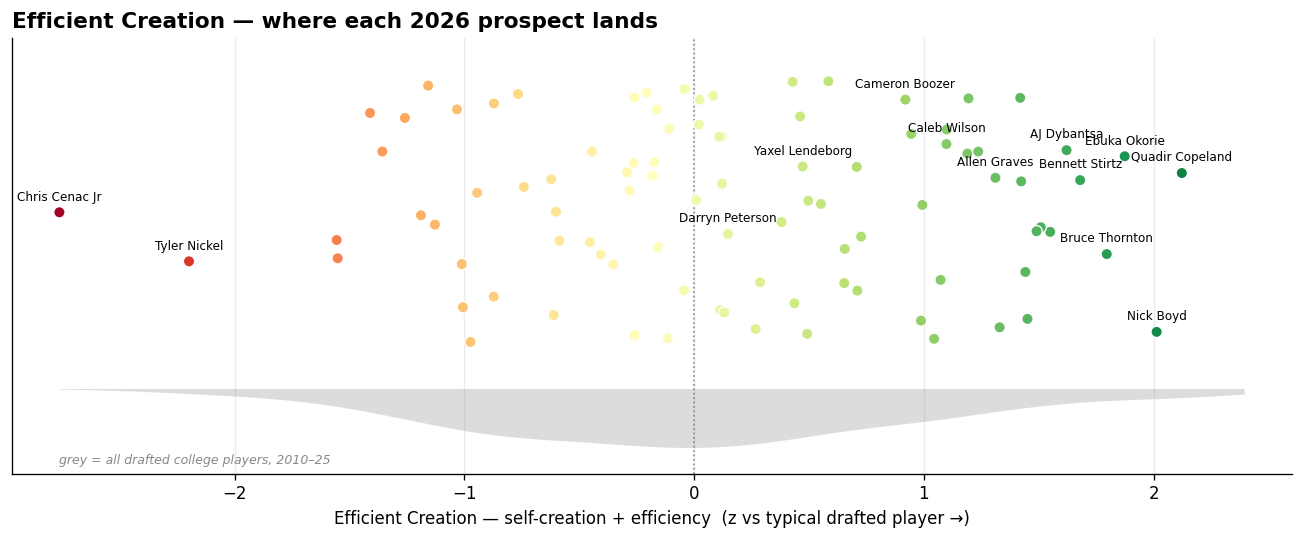
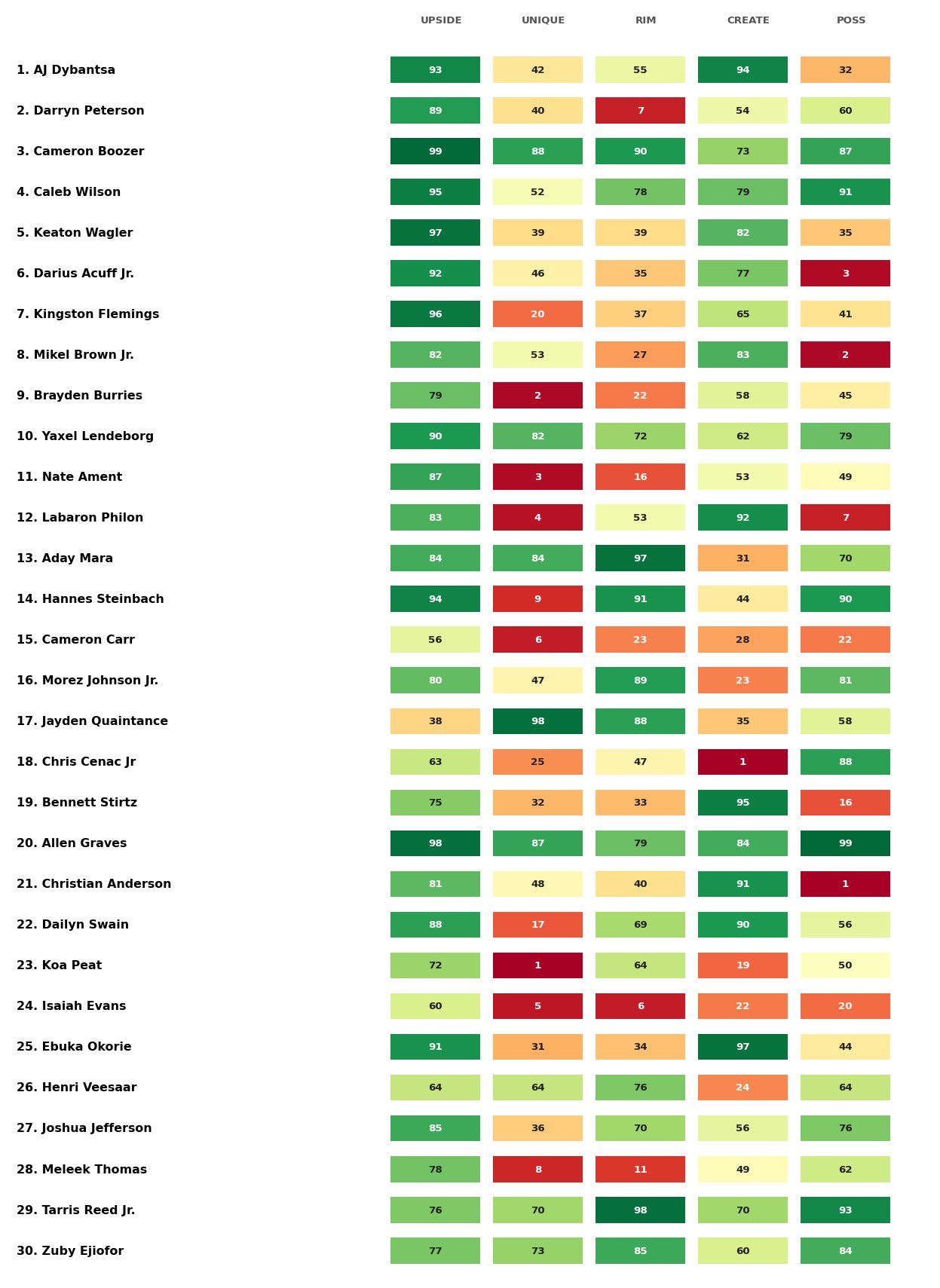
To get at the variance reduction piece of the puzzle, I just put together some simple composite stats for the Rimfluence, Creation, and Possession aspects of DBCJason’s philosophy. Each is just a weighted average of z-scored college rates. Each is far from perfect.
Rimfluence = (0.18·rim FG%) + (0.18·off-reb rate) + (0.15·rim-attempt share) + (0.15·assist rate) + (0.15·block rate) + (0.12·def-reb rate) + (0.07·dunk rate)
Efficient Creation = (0.34·unassisted-make %) + (0.16·unassisted-3 %) + (0.15·true-shooting %) + (0.15·assist:turnover) + (0.12·free-throw rate) + (0.08·usage %)
Possession Economy = (0.25·off-reb rate) + (0.22·steal rate) + (0.18·def-reb rate) + (0.15·block rate) − (0.20·turnover rate)
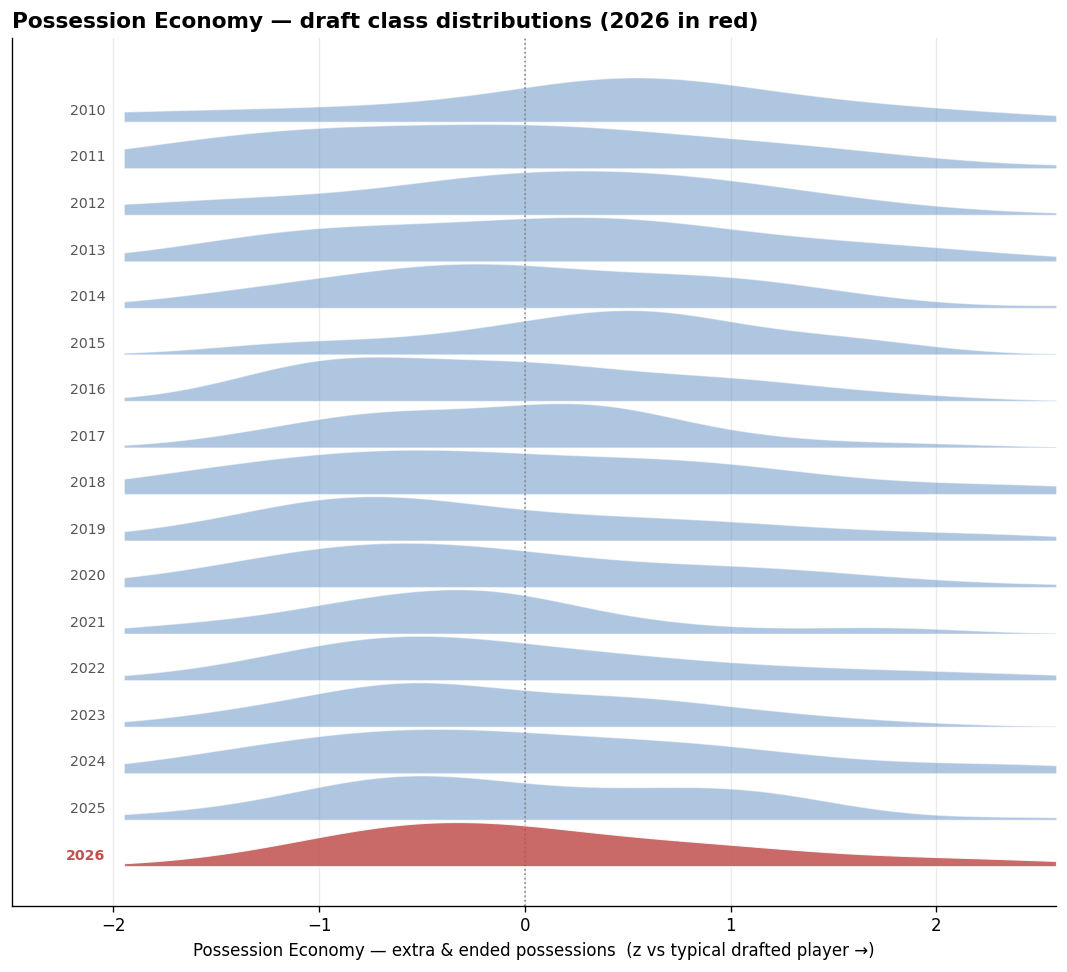
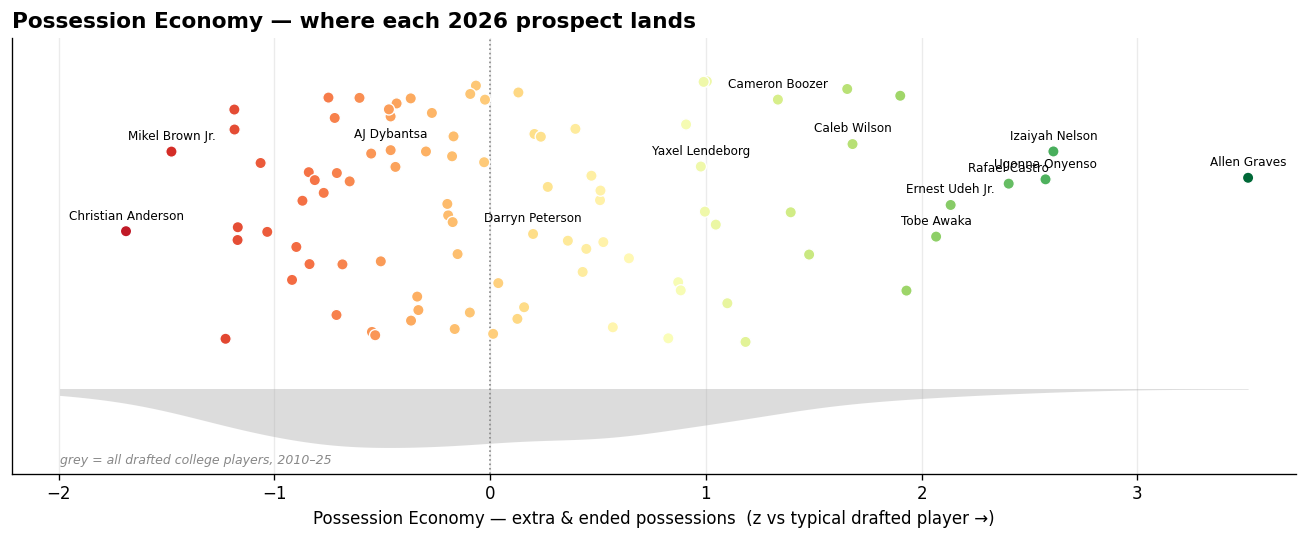
Philosophy Score Card
Here is how we could score the top 30 consensus prospects based on percentile rank in these criteria:
Applied to the entire class, a few prospects in the 60th+ percentile in both uniqueness and upside stand out to me:
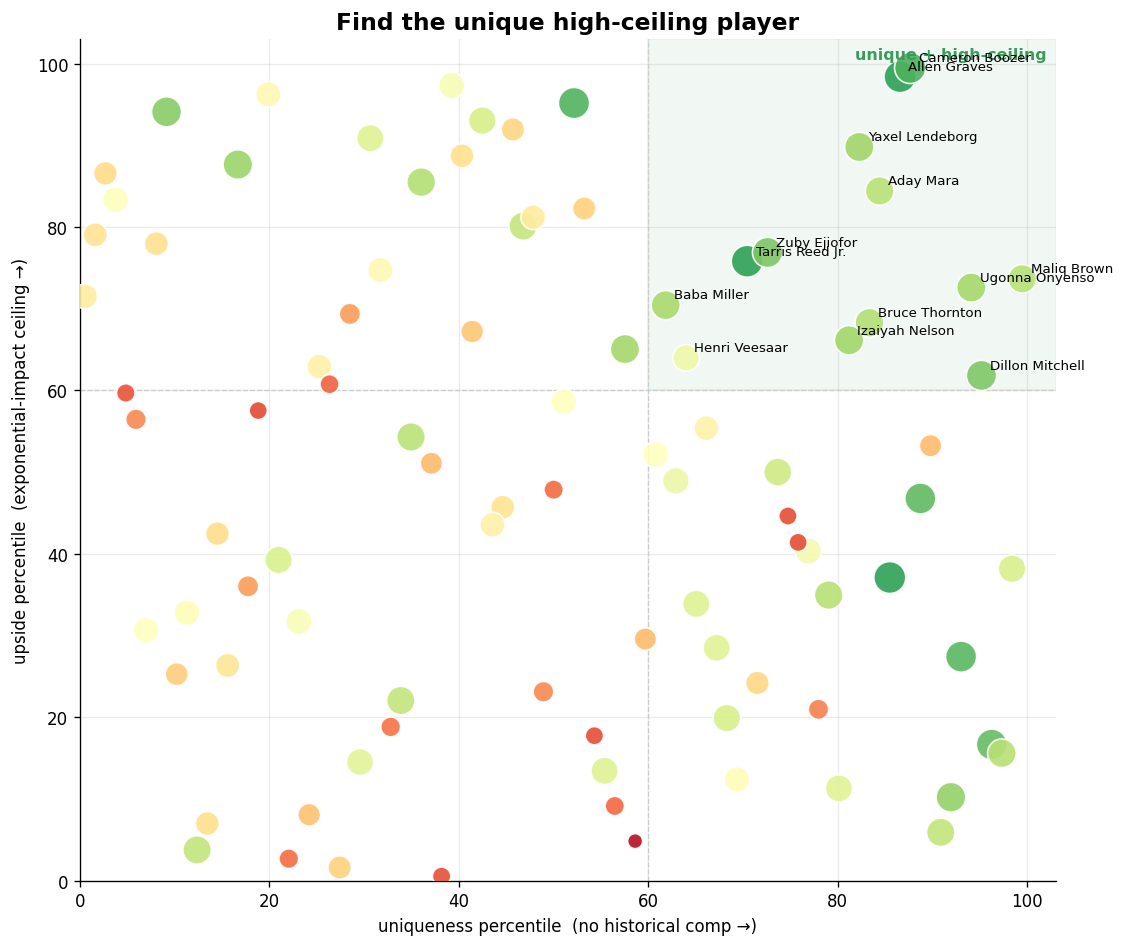
The unique and high upside names generally match the players I valued highly in whatever mental model I had going into this project. I’m exceptionally high on Cameron Boozer and Allen Graves. I’m quite high on Aday Mara. My favorite later picks include Baba Miller and Maliq Brown. So in terms of finding a model that matches how I understand basketball currently, I think this works pretty well.
I think this all works a lot less well when it comes to ordering players. I’m not really sure how much I value a big board in the first place. I get on some level that you need to rank order the players in a draft, but I’d think of this project as something that could inform that process later on.
Ultimately, for the greatest returns in basketball, I think you want to be non-consensus and right. Being non-consensus is quite easy. Not so sure about the being right part.
Robert Caro, Thanksgiving, and the NBA. Three things you’d find me at the center at of a Venn Diagram