
Using the Second Round Pick Exception for Salary Matching in Trade
Turning draft rights into tradable salary

I’ve been thinking about the second round of the NBA draft. With so many players returning to college, draft classes will be relatively shallower than before. That makes me think draft-and-stash second-rounders will tick up, and teams will look for creative uses of those assets. The Second-Round Pick Exception (SRPE) is potentially the lever.
The 2023 CBA created the SRPE, which lets a team sign a player whose second-round rights it holds to a multi-year contract without using cap space or another exception. It filled a gap where first-round picks could be signed via the Rookie Scale Exception, but second-rounders had no equivalent, which funneled most of them into minimum deals or two-way contracts. Article VII, §6(k) was written to give teams a cleaner way to sign second-rounders to longer deals and give those players a better path to sticking. Generally, it’s a win-win.
But as with any new rule, novel (unintended) uses tend to surface. I think that’s the case here. There’s a somewhat convoluted way to use the rights you hold over previously drafted second-rounders to sign them to a barely-above-minimum, partially guaranteed deal purely for salary-matching purposes in a trade.
I’ll walk through it below.
Proposed Strategy
The SRPE can be used on any second-round pick whose draft rights the team holds. There’s no limit to how many draft rights a team can hold. There is no limit on how many SRPE contracts a team can sign in a given season (other than roster spots). There is also a 30 day period in July where signed SRPE contracts don’t yet count on the books.
So, this produces an ability to:
Hold draft rights to a bunch of second-round picks at little cost,
Sign a few of them in July to SRPE contracts paying just above the minimum in year 1 and non-guaranteed in years 2+,
Wait 30 days, and
Aggregate these short-term, partially guaranteed salaries for salary matching in a trade.
The idea is conceptually similar to the Knicks’ use of barely above minimum sign-and-trade deals to salary match in the KAT trade, but with some added hurdles.
Rule Foundations
Here are the general foundational rules to understand for this:
SRPE
A team that holds the draft rights to a Second Round Pick may use the Second Round Pick Exception to sign such a player to a Player Contract in accordance with [the structure outlined below]. Article VII, Section 6(k).
From July 1 through July 30, if a Team signs a Player Contract pursuant to the Second Round Pick Exception, such Contract will not be included in Team Salary until July 31 of such Salary Cap Year. Article VII, Section 4(l).
SRPE Contract Structure
The term of a Player Contract signed pursuant to the Second Round Pick Exception must be either: (i) two (2) Seasons with an Option in favor of the Team for a third Season; or (ii) three (3) Seasons with an Option in favor of the Team for a fourth Season. Article VII, Section 6(k)(1).
As set out in Article VII, Section 6(k)(2): If the contract is signed for two seasons with an option in favor of the team for the third season, the structure must look like this:

As set out in Article VII, Section 6(k)(3): If the contract is signed for three seasons with an option in favor of the team for the fourth season, the structure must look like this:

Aggregation Limits
Other than during the period from December 15 through the trade deadline each Season, if a Team is aggregating the Contracts of 3 or more players in a trade, and the number of Contracts being aggregated exceeds the number of Replacement players, then no more than one “Minimum Traded Player” may be among the aggregated Contracts. Article VII, Section 6(j)(4)(ii).
A “Minimum Traded Player” is a player whose Contract provides for his applicable Minimum Player Salary for the Salary Cap Year in which the trade of his Contract occurs or, if the trade occurs during the period beginning on the day after the last day of the Regular Season of a Salary Cap Year through the last day of such Salary Cap Year, a player whose Contract provides for his applicable Minimum Player Salary in the immediately following Salary Cap Year.
Trade Timing
No Draft Rookie who signs a Standard NBA Contract or player who signs a Two-Way Contract may be traded before thirty days following the date on which the Contract is signed. Article VII, Section 8(d)(i).
Just for total clarity: A Draft Rookie is a Rookie who is selected in the draft and a Standard NBA Contract is any contract that is not a Two-Way.
In Summary
In plain English: §6(k) is the signing tool (multi-year deals just above the rookie minimum, no guarantee required, no usage cap). §6(j)(4)(ii) is the rule the play works around (three-or-more contract aggregations can’t include more than one minimum deal — but anything above the minimum is treated differently). §4(l) is offseason cushioning (July signings don’t hit Team Salary until July 31). §8(d)(i) is the binding timing constraint (rookies become trade-eligible 30 days after signing).
The Mechanism
Ok, so stack §6(k) and §6(j)(4)(ii).
You have this player you selected in the second round a few years ago. Sign him under §6(k) to a two-year deal with a third year team option, Year 1 priced somewhere between the rookie minimum and the §6(k) ceiling, Years 2 and 3 non-guaranteed. Year 1 is above the §6(j)(4)(ii) minimum-contract threshold, so the contract aggregates freely. Years 2 and 3 carry no guarantee, so whichever team holds the contract after the trade can waive (and you may even send them cash to compensate). Wait 30 days for §8(d)(i) to clear.
Now, the contract is essentially an expiring small salary. Stack three or four of them and the team has manufactured a block of somewhere around $6-9 million in matching salary. This could be a pretty useful tool for salary matching in trade if you have a good idea that a certain trade framework will occur.
Logistical Considerations
Of course, it’s easier said than done. This is strategy has a bit more to consider.
30-Day Waiting Period. Rookies signed to Standard Contracts must be under contract for 30 days before becoming trade eligible. This presents a significant, but not insurmountable, timing restriction that requires advance planning and alignment with potential trade partners. See, for example, the 2014 Andrew Wiggins trade.
Roster Spot Management. During the offseason, Teams may carry up to 21 players. By opening night, this must be reduced to 15 standard contracts. Teams must ensure they, and their prospective trade partner, have sufficient roster space to execute and hold SRPE contracts.
Agent/Player Cooperation. The SRPE-signing players and agents must cooperate with the proposed structure. While some players may welcome the short-term financial upside, others may resist for various reasons. Holding the rights to multiple stash players helps mitigate this risk.
Apron Considerations. This trade strategy requires aggregating contracts, which hard-caps a Team at the Second Apron Level. But, it allows a team to bypass the First Apron Level hard cap that comes with taking back more money than you send.
And relying on draft-and-stash players for this strategy presents some additional hurdles:
FIBA Letter of Clearance. To sign a player currently under contract in a FIBA-affiliated league, the team must obtain a Letter of Clearance (LOC). This can be a relatively slow process, even with cooperation. There is also an additional LOC needed for the player to return to the FIBA-affiliated league.
Waiver Period. NBA rules require a 48-hour waiver window after a player is waived, further delaying the player’s return to his FIBA-affiliated league.
European Season Timing. Depending on the trade timing, international clubs may resist mid-season disruption to facilitate trade.
NCAA Draft-and-Stashes? I’m pretty sure this could exist. Like what is James Nnaji doing right now, I think that’s a NCAA draft-and-stash for the Knicks, right? Assuming this is something that happens more often, there is probably some added friction in the player temporarily signing an NBA contract and moving back to the NBA. That said, the NCAA has no (enforceable) rules!
Even considering these drawbacks, the benefits of using draft-and-stash players in this framework are still valuable. You can hold them for pretty much however long you want at no on the books cost. And with NIL decreasing the depth of draft classes, the opportunity cost of using a second round pick in this way is lessened.
Holding Draft Rights
I’m pretty sure every team should make more of an effort to hold draft rights to players. That is, other than the Knicks. Look at how many draft rights they hold!
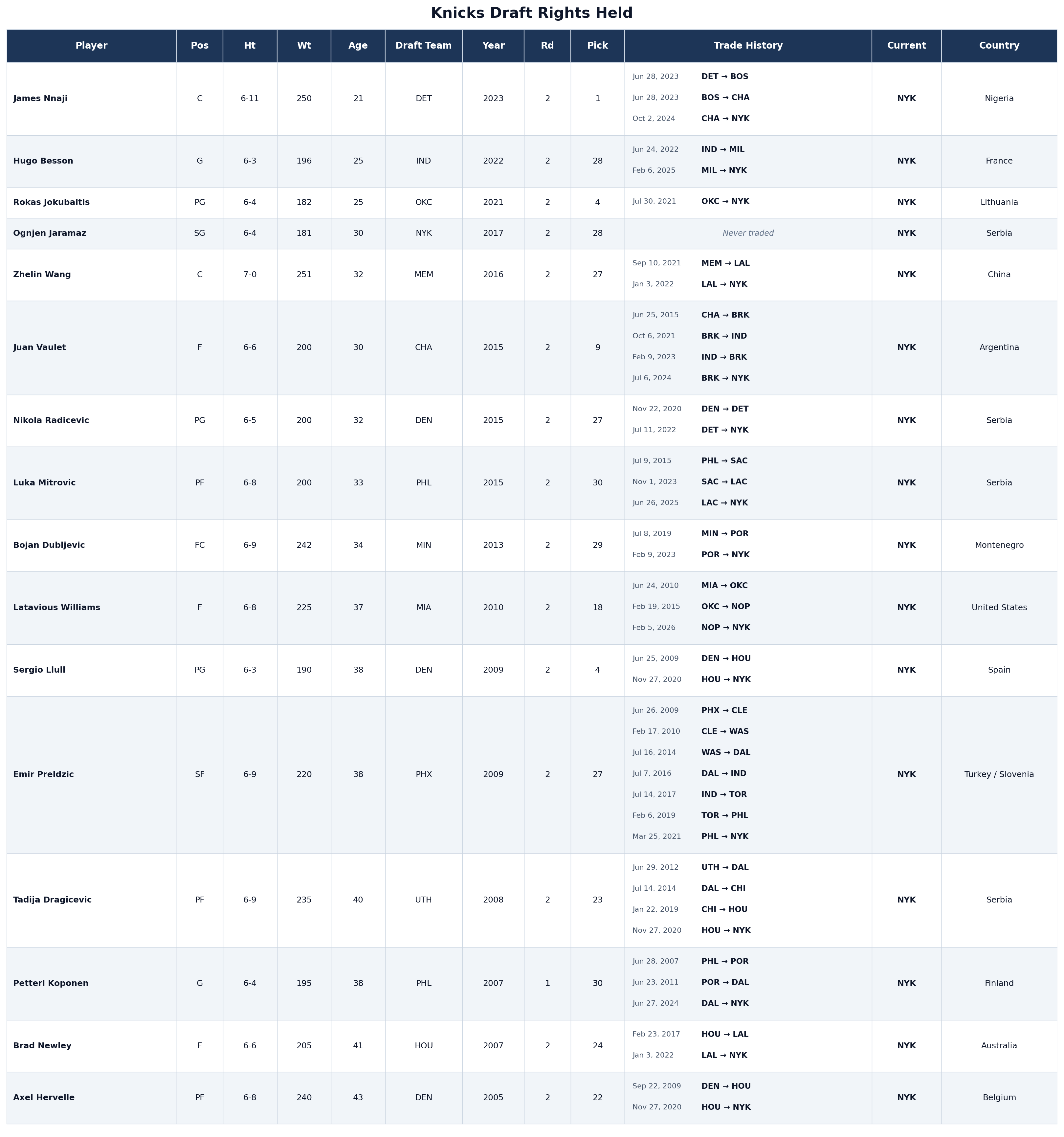
The Cavs had a bit of a stockpile for a little as well, so I’d guess it’s somewhat of a pet project of Brock Aller. I’m sure he is angling to use these in some way in the future.
Generally, holding draft rights seems quite low cost. I’m not sure why you wouldn’t try to pick them up as you go along in various transactions. You never know when rules may change and open up additional opportunities to use them in creative ways.