
The NBA Middle Class
A look at contract signings since 2018

If you Google “NBA middle class,” you’ll find plenty of pieces arguing that the new CBA has killed (or is killing) this tier of contracts. Most of these pieces are from a few months ago. And I totally meant to look into this then. But I didn’t. So here I am, 3 months late to the debate party.
The argument is pretty straightforward. Something like:
The Apron rules make it harder for high-spending teams to carry multiple sizable salaries.
Stars will always get paid.
Rookies will always be cheap.
All that’s left in between is a middle class fighting for limited capital.
So, the middle class will get squeezed.
It’s not an unreasonable theory. You can always anecdotally point to a solid veteran who ended up signing for the minimum and say, “See? The middle class is disappearing.” In the aggregate, though, the narrative hasn’t matched my sense of what’s actually happening.
Here’s why.
The Data
To build this dataset, I pulled contract information from Salary Swish. The site’s free-agent pages list the exact date each contract was signed, which allowed me to assign every deal to a specific league year. I defined a “league year” for contract-signing purposes as the period between trade deadlines. That choice folds early in-season extensions into the prior offseason and treats late-season extensions as part of the upcoming one. It’s an arbitrary cutoff in one sense, but it aligns with how I generally think about contract cycles.
I excluded in-season minimum deals (10-days, prorated minimums, hardship contracts) and non-guaranteed signings. Those moves are mostly about in-season roster management, not the actual contract market I’m trying to analyze. For this project, they didn’t feel relevant to the question at hand, so I left them out. Though I don’t think it would be crazy to include them if you’re doing this analysis yourself.
I also excluded rookie contracts, since the rookie scale dictates their value. They aren’t set by market dynamics, so they don’t add much value in the middle-class discussion.
Distribution of all signed contracts
The below gives us a big-picture view of the market. Overall, the distribution of signed contracts is pretty stable year over year (i.e., it has a similar shape). There’s a predictable spike at the minimum, and the numbers generally taper off as you move toward the top end of the market.
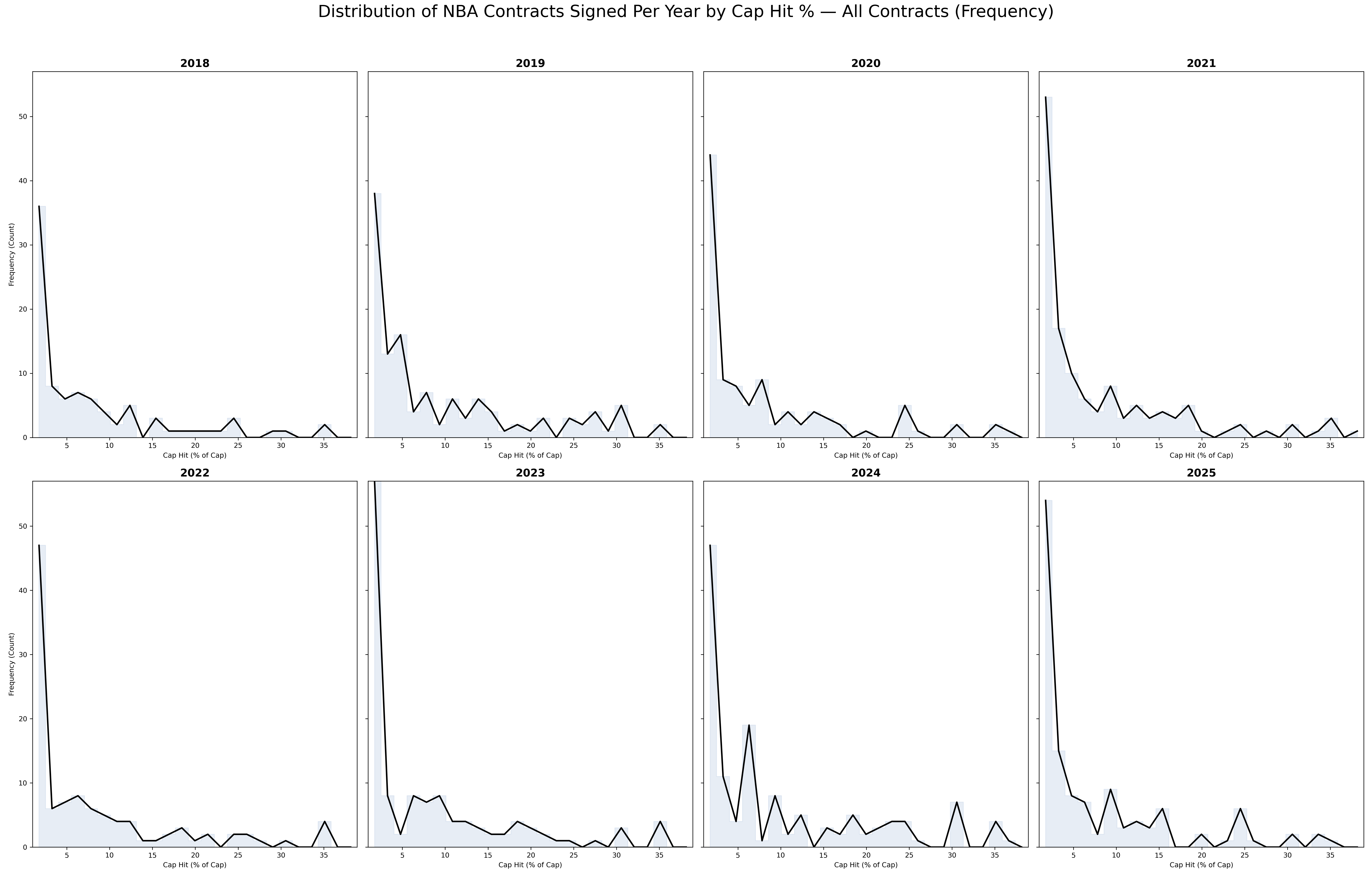
When you bucket these contracts into a few broad groups, the year-over-year distribution also stays largely consistent, with some modest variance from season to season.
I sort of created these buckets arbitrarily. You could spend a good bit of time trying to properly define what is and isn’t the middle class of the NBA. For now, treating the 8–18% of the Cap range as a rough middle-class tier is probably good enough.
Distribution of contracts signed, excluding extensions
A secondary argument/narrative tied to the death of the middle class is the supposed death of free agency. The usual explanation is that extensions have become more common, so fewer players actually reach the open market. That dynamic was especially noticeable in 2023 and 2024.
So, it seemed worthwhile to remove extensions from the dataset and see if anything changed. But when you look at the Cap-hit distribution of non-extensions signed each year, the overall shape is still generally consistent.
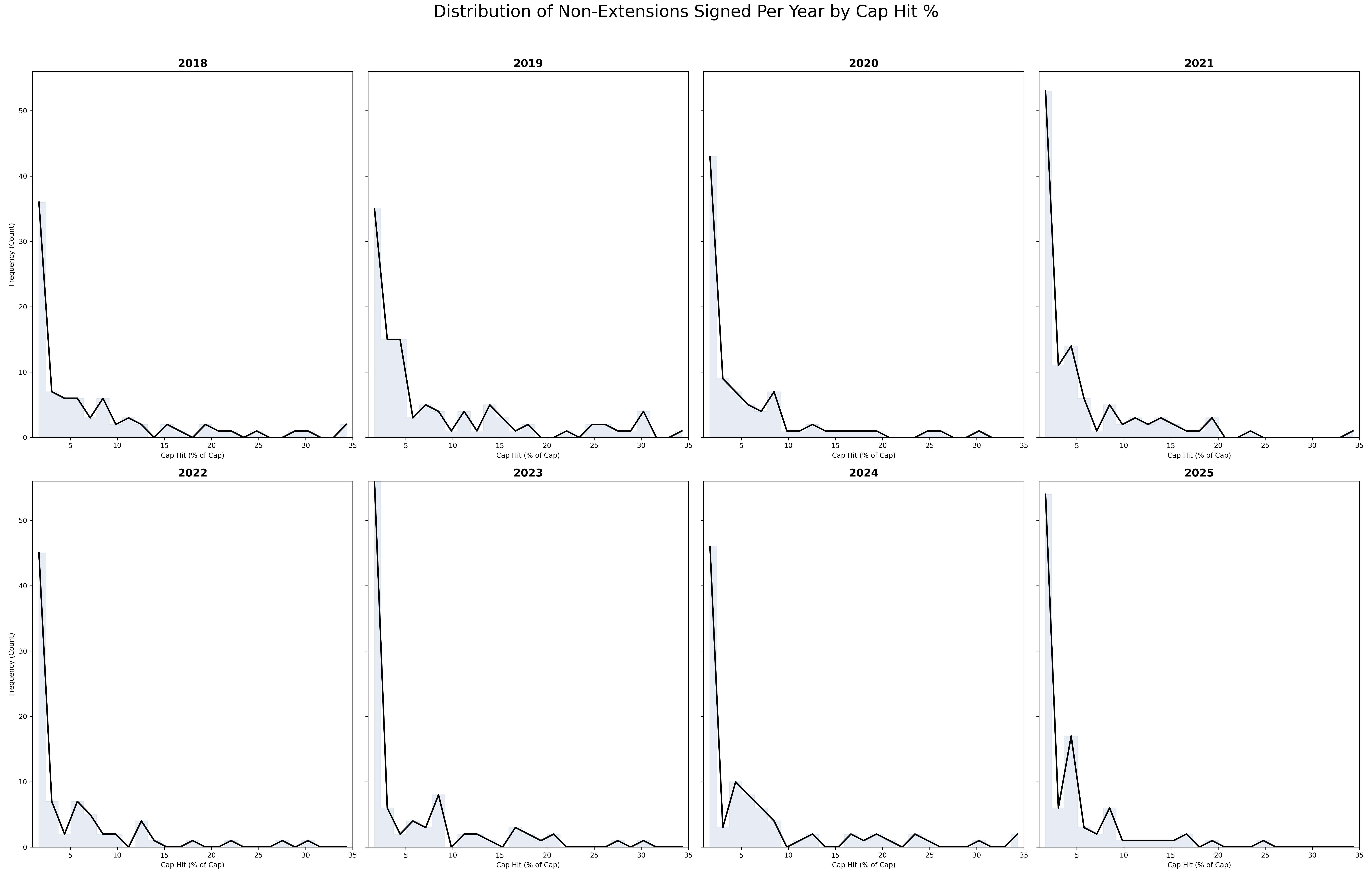
I think the strongest case for a “squeezed” middle class this summer has less to do with a long-term league trend and more to do with the specific 2025 landscape, where very few teams had real spending power above the mid-level. But when you zoom out to the full sample, the share of non-extensions signed each year by bucket has been relatively consistent as well.
Distribution of extensions signed
This is probably my favorite distribution. Pure chaos.
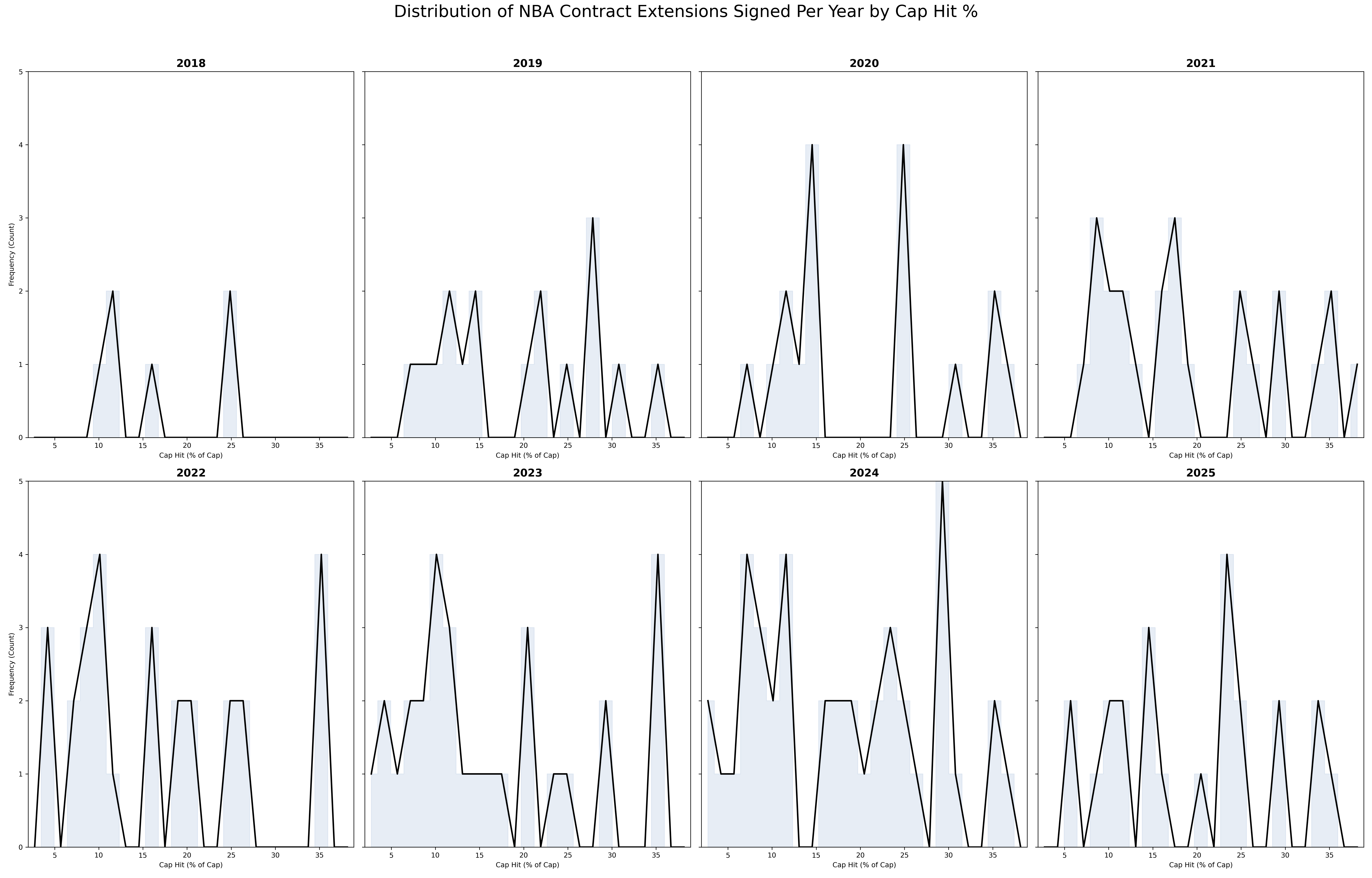
Really, I just felt obligated to show the extensions distributions because I showed the non-extensions one. I don’t think there is that much of a takeaway here.
Extensions are generally dominated by the middle class and above, though more recently, teams are signing players to extensions at lesser amounts (which I think is generally a pretty low-risk, high-upside strategy).
Where does the narrative come from?
None of this means the middle class is thriving or that individual players aren’t getting squeezed in specific circumstances. But the general “NBA middle class is dead” narrative isn’t reflected in the last several years of data. The market still produces roughly the same distribution of deals. Extensions have absorbed some of the action, Cap mechanics have shifted some of the timing, and 2025 created a uniquely tight spending environment. But the middle class, as a tier, has mostly held steady.
Here’s what I offer as the origin of the narrative: it starts with the assumption that the Apron rules will materially reduce how much teams spend. If that’s true, then you can build out the next steps. Stars will still command max contracts, and rookies will still get their rookie-scale amounts. Those are fixed points. So if total spending declines, the only place for teams to cut is in the middle. That’s where the “squeezed middle class” idea comes from.
But it’s not clear that the fundamental assumption that spending will decrease is true. At least, it hasn’t been true yet.
League-wide allocations have consistently landed in the 120–130% range of the Cap (multiplied by 30 teams). If the CBA were meaningfully constraining spending, we’d expect those allocations to fall as a share of the Cap. They haven’t… yet. Teams may respond to the new environment in a way that limits spending. But, until then, there’s not much truth to the middle class or Apron panic.