
The "Mutual Option"
Spoiler: I don't think they're mutual options

Free Agency is under way. As reported deals have rolled in, I’ve seen a few reports of contracts with a “mutual option”.


I don’t think we’ve seen these pop up before in the NBA space (contract innovation is fun!) and it has spurred some debate on the internet about what these options mean.
From the outside looking in, here’s my best shot at figuring it out:
What is a mutual option in the first place?
A good place to start is probably figuring out what a mutual option is in other contexts. I think the idea behind them is actually pretty intuitive. It’s an option that is triggered when both parties agree that it should be triggered. You’re with your significant other because you each decide to be with one another. Every day you are exercising your mutual option to enter into and stay in the relationship for another day. Same with your at-will employment. Same with a conversation with the neighbor. And so on. We live in a world of mutual options.
Generally speaking, in more concrete contractual terms, a mutual option provides that a thing will happen later if both parties agree to exercise the option. They say something like “X further obligation applies only if both parties agree that it applies by Y date”.
Deal parties like mutual options as a way to preserve some future flexibility while having a soft commitment in place. They like saying “we think this is a good deal today, and we like working together, so let’s just put it in writing that if both of those things are true later, we’ll agree to do the deal again.” It, at least in theory, saves on some transaction costs down the road if things remain status quo.
And as opposed to the alternative of “we think this is a good deal today, and we like working together today, so let’s assume these things will be true later and lock it all in today,” it gives the parties some way to manage risks if today’s world conditions don’t clearly map onto tomorrow’s.
Mutual Options in the MLB
Conveniently, another sport already uses mutual options. MLB contracts can include a final option season that is guaranteed only if both the player and the club exercise their sides of the option. In reality, these are rarely exercised. Which makes sense. If the player has a stronger season than currently valued, they won’t exercise their side of the option because they can go get more money elsewhere. And if the player has a worse season than currently valued, the team won’t exercise its side of the option because it doesn’t want to overpay the player. It takes something of a Goldilocks scenario for each side to look at the option and each say “yep, this works for me still.”
The MLB also has some deferred money mechanics that might change the calculus a little bit. The takeaway is the same: mutual options require both parties to exercise their option, which is rarely in each party’s respective best interest.
As reported, these don’t seem like mutual options…
Ok, so generally a mutual option requires both parties to exercise their side of the option for the option to take effect. But that’s not really what I’m picking up from the reports. At least not necessarily.
Here are the reports that we’re working with:
Hartenstein: “a unique mutual option that allows both parties to rework the agreement again in 2028 prior to the final season”
Wagner: “a mutual option guaranteeing the $19M while allowing either side to opt-in (not opt-out) along with having a conversation about doing a new contract next summer”
Ellis: “a full mutual option that fully guarantees the $18M for Ellis while allowing both sides to have a conversation about a new deal next summer, but either party can opt-in (not opt-out)”
I think the operative part of these descriptions (assuming accurate) is “either party can opt-in.” Not necessarily “both parties must opt-in” or something similar. This flowchart from Mike Vorkunov shares my thinking:


This seems best understood as the player holding a player option, and the team separately holding a team option. Concurrently. If either exercises their right to opt-in, then the contract continues.
So if these are options exercised if either party opts-in, that doesn’t really sound like the mutual options we described above, right? It’s sort of like an either-party option? A dual option? Or maybe a dual unilateral option? I’m not good at naming things, but whatever we call them, we probably shouldn’t just call them mutual options.
In fact, they’re sort of totally different! A mutual option works on "and" logic: the year happens only if the team wants it and the player wants it. I’m understanding the above to be using "or" logic: both sides hold the trigger, and if either one pulls it, the year vests and binds both parties.
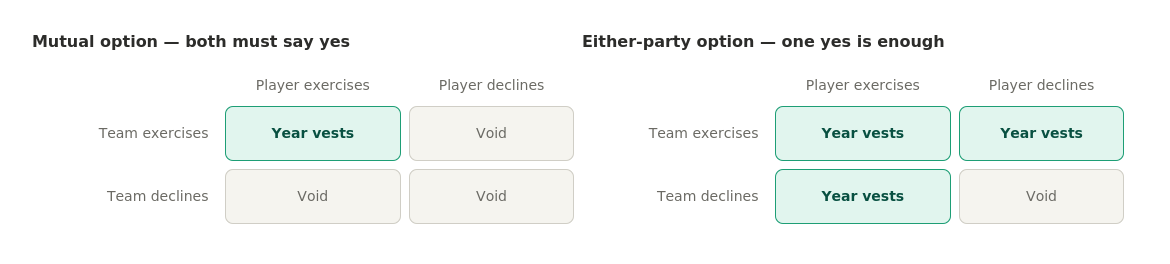
So two questions pop into my mind pretty quickly:
why would parties do this?
how can parties do this? (they can do this, right??)
Why would parties do this?
The grid visual above is a good place to start. The team opts in when the player is a bargain at the number. The player opts in when the number beats his market. Since the agreed salary is almost never exactly what the player turns out to be worth two years later, one side or the other will nearly always want to pull the trigger. So where the MLB mutual option is a contract year that almost never happens, the either-party option is a contract year that almost always does. "And" logic collapses toward void; "or" logic collapses toward guaranteed. Extra steps, either way.
Some plausible reasons why parties prefer this:
A scheduled repricing point. It’s generally pretty hard to renegotiate a contract in the NBA. This dual option builds something of an offramp for the parties to reconnect and see if a change in terms might be mutually beneficial, with each side having the backing of agreed upon terms to fall back on.
Leverage. Relatedly, when the parties sit down in the option year, nobody can bluff about leaving, because nobody can leave unilaterally. Separation takes both sides, staying takes one. The threats that normally drive contract standoffs aren’t quite there. Viewed this way, the clause is less a new kind of option year than a pre-agreed negotiation structure for the deal after this one.
Transaction costs. If the option decision time arrives and the deal still looks roughly right to each side, nobody really has to do much of anything. In a world where the parties want some aspect of flexibility, this is one where they save the most on the costs associated with it.
Risk smoothing. A single-sided option loads all the market risk onto whoever doesn't hold it: the player eats the downside under a team option, the team eats it under a player option. This structure reflects the risks of a guaranteed deal, with the added flexibility noted above.
Everyone gets to say they got an option. This one is maybe silly but also maybe reflects the real world. Since the only options we really know of right now are the unilateral ones, maybe it still feels important to leave a negotiation saying you got one (even if it’s not quite the leverage the traditional options are). In a world where news breakers share agent details with every contract, maybe that matters a bit, too.
Others. And I’m sure quite a few other angles I haven’t yet thought of (let me know of any you think of).
How can parties do this? (they can do this, right??)
I think this is fine to do. I suppose we won’t know for sure until the league clears these deals. But I haven’t found anything in the CBA saying that the player and team can’t hold options concurrently (though, Larry Coon’s CBA FAQ, interestingly enough, does make that conclusion).
Here’s my general overview of Article XII of the CBA, which covers options:
Section 1 tells us that you can’t have a team option… unless it’s a team option that (1) is negotiated between team and player, (2) authorizes the extension of the contract for no more than 1 year beyond the stated term, (3) is exercisable only once, (4) provides the salary, likely bonuses, and unlikely bonuses in the option year of no less than 100% of the same in the last year of the stated term, and (5) other than SRPEs, provides everything else in the option year that matches the last year of the stated term.
Section 2 tells us that you can’t have a player option… unless it’s a player option that (1) is negotiated between team and player, (2) authorizes the extension of the contract for no more than 1 year beyond the stated term, (3) is exercisable only once, (4) provides the salary, likely bonuses, and unlikely bonuses in the option year of no less than 100% of the same in the last year of the stated term, and (5) provides everything else in the option year that matches the last year of the stated term.
Section 2 also allows for Early Termination Options (which I can get into another time — they’re fun!), which essentially function as an option for a player to opt-out of the contract.
Section 3 says the option can’t be conditional on anything. It’s either there when you sign it or not.
Section 4 tells us that options must be exercised by a certain time.
Section 5 tells us that the NBA will give the Players Association copies of these notices.
All that to say, nothing in Article XII seems to prevent a dual option. I’ve done a cursory look elsewhere in the CBA as well and haven’t come up with anything that supports Larry Coon’s conclusion that a player and team can’t hold the options concurrently. My best guess is that Larry is misinterpreting the “can only be exercised once” portion of each section, which only applies to each respective player and team option.
In Sum
So: these probably aren't mutual options, at least not as anyone else uses that term. They're dual options (concurrent player and team options on the same year) running on "or" logic where the traditional mutual option runs on "and." That flips the default from separation to continuation, which is probably the point: the parties get a near-certain year, a scheduled chance to replace it with something better, and a fallback neither side needs the other's permission to invoke. And as best I can tell, nothing in Article XII stops them.
Contract Innovation is Fun
It’s maybe telling that I’ve found this among the most fun things to happen so far in Free Agency. The CBA is a legal document. Like any legal document, there is a lot of grey area. There’s a lot of opportunity for teams to do fun things in the grey area. This is one of them.
I think there’s another relating to No Trade Clauses as well, which I’ve written about before. Maybe a team will try this out next:

I saw some posts saying that mutual option year is partially guaranteed. Based on my knowledge, the option year should have the same salary protection as the prior year’s. It makes me guess that mutual option year is a player option with a guaranteed date shortly after. Otherwise like you said, it’s not really mutual if either side can decide (opt-in).