
NBA Trade Notes (2/3/2026)
MEM-UTA; CHI-MIN-DET; BOS-CHI; CLE-LAC

A trade creating a $28M+ TPE?

A trade with cash considerations?

A trade with James Harden?

That’s a nice pre-deadline Tuesday. Let’s dive in:
UTA-MEM


Trade Mechanics
Utah
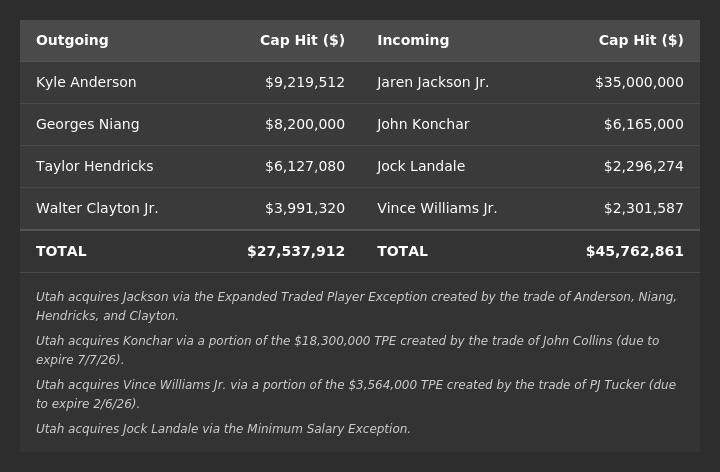
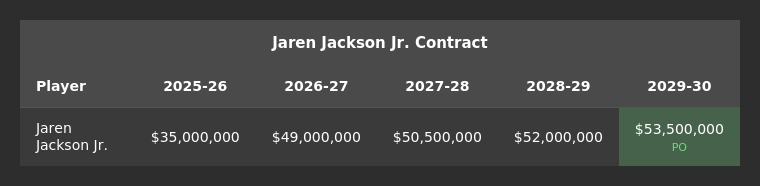
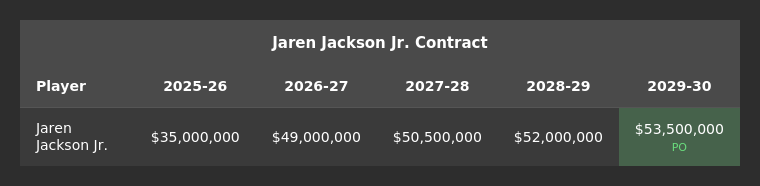
Utah acquires Jaren Jackson Jr. ($35,000,000) via the Expanded Traded Player Exception created by the trade of Kyle Anderson ($9,219,512), Georges Niang ($8,200,000), Taylor Hendricks ($6,127,080), and Walter Clayton Jr. ($3,991,320).
Utah acquires John Konchar ($6,165,000) via a portion of the $18,300,000 TPE created by the trade of John Collins (due to expire 7/7/26).
Utah acquires Vince Williams Jr. ($2,301,587) via a portion of the $3,564,000 TPE created by the trade of PJ Tucker (due to expire 2/6/26).
Utah acquires Jock Landale via the Minimum Salary Exception.
Utah also acquires the three 1st Round Picks: (1) most favorable 2027 of CLE/MIN/UTA; (2) 2027 LAL, and (3) 2031 PHX.
Memphis
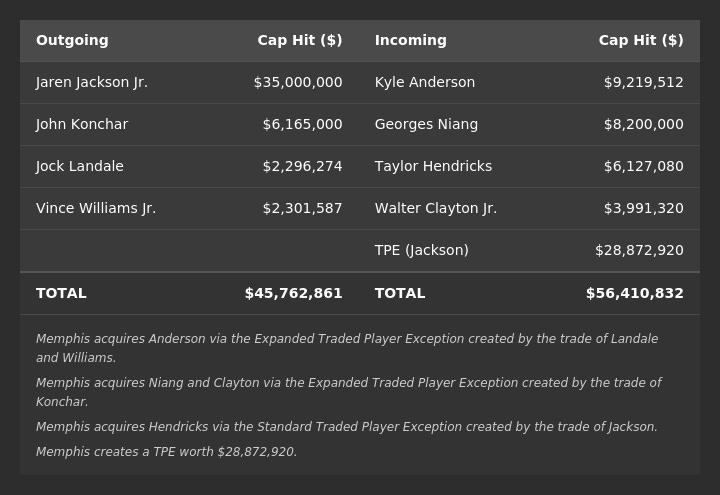
Memphis acquires Kyle Anderson ($9,219,512) via the Expanded Traded Player Exception created by the trade of Jock Landale ($2,296,274) and Vince Williams ($2,301,587).
Memphis acquires Georges Niang ($8,200,000) and Walter Clayton ($3,991,320) via the Expanded Traded Player Exception created by the trade of John Konchar ($6,165,000).
Memphis acquires Taylor Hendricks ($6,127,080) via the Standard Traded Player Exception created by the trade of Jaren Jackson ($35,000,0000). Memphis creates a TPE worth $28,872,920, which will expire one year from the date the trade is finalized with the league office.
Strategic Implications
Utah
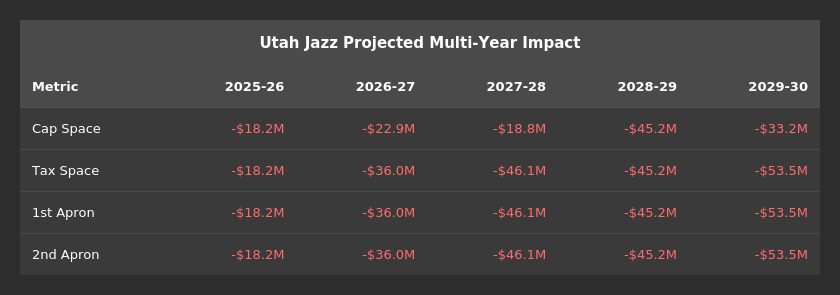
Jaren Jackson Jr. is very good at basketball. I sort of feel like it is easy to overlook this part around trade deadline time. The Jazz used an advance on their upcoming cap space to acquire a player they evidently think fits their build very well. Jackson is one of the best defensive bigs in the league, stretches the floor, and is just 26 years old. My general Utah thesis is that they want to be good, big, and versatile. They got a player who is good, big, and versatile.
Why acquire Jackson Jr. now? You may recall that Memphis recently renegotiated and extended his contract. This resulted in his 2025-26 salary being a good bit less than his salary for the remaining years. Which, in turn, makes it easier to acquire Jackson from a salary matching perspective (Utah has to send less salary).
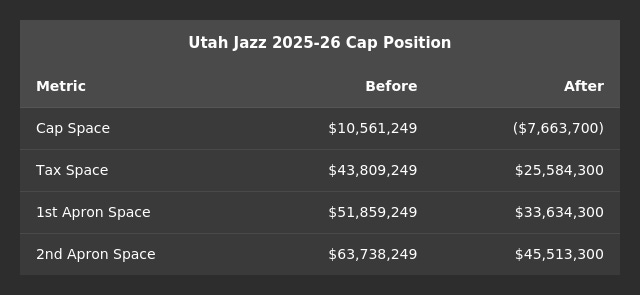
Utah Tax Space. Utah still has $25 million under the Tax Level to play with this deadline. They still have the expiring contracts of Nurkic ($19,375,000) and Kevin Love ($4,150,000) at their disposal. If I were a betting man (I’m not) and had to bet (I don’t), I’d bet that Utah has some more moves up its sleeve this week.
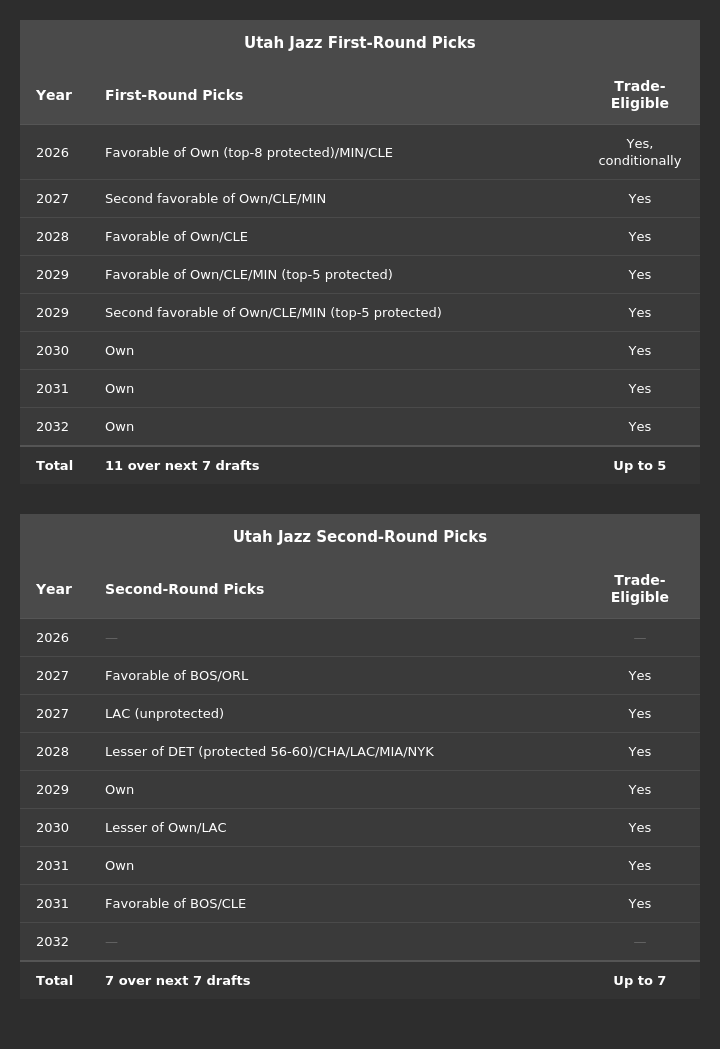
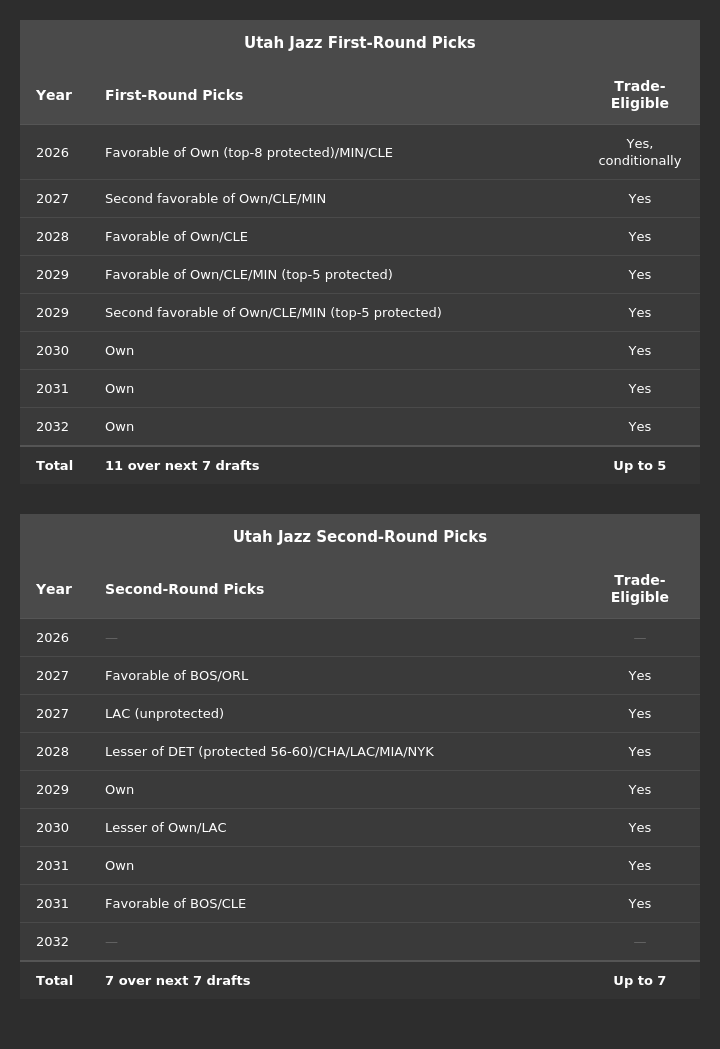
Draft Capital. Three outgoing 1st round picks is obviously quite pricy. Some view the 2027 draft as particularly weak, which can lessen the perceived value of the two 2027 picks. The 2031 PHX pick is, in my estimation, particularly valuable (insofar as any far future unprotected first is). That said, Utah still has a surplus of draft capital at their disposal:
Memphis
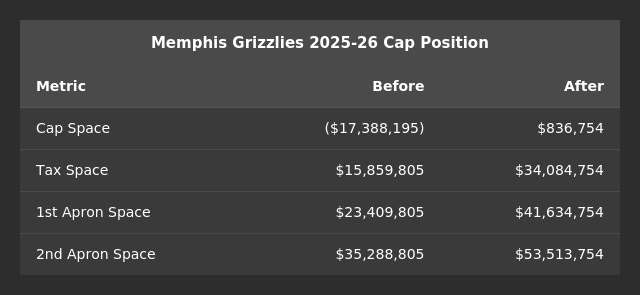
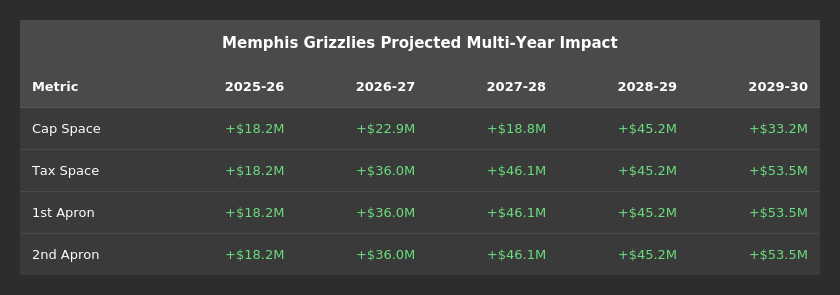
Starting a rebuild. It’s always easier to start a jumpstart rebuild when you have good stuff to trade away in the first place. The returns for Bane and Jackson are about as good as you could hope for. I’d expect much less in the seemingly inevitable Morant trade (but not certain it is by the deadline).
More moves to come. Memphis now has a $34 million in tax space and some moderately sized contracts that they’ll be open to moving. I’d consider just about everyone on this roster available, with the exceptions of Edey, Coward, and maybe Jaylen Wells/Cam Spencer. The biggest names to keep an eye on are, of course, Morant, Caldwell-Pope, Brandon Clarke, and Santi Aldama.
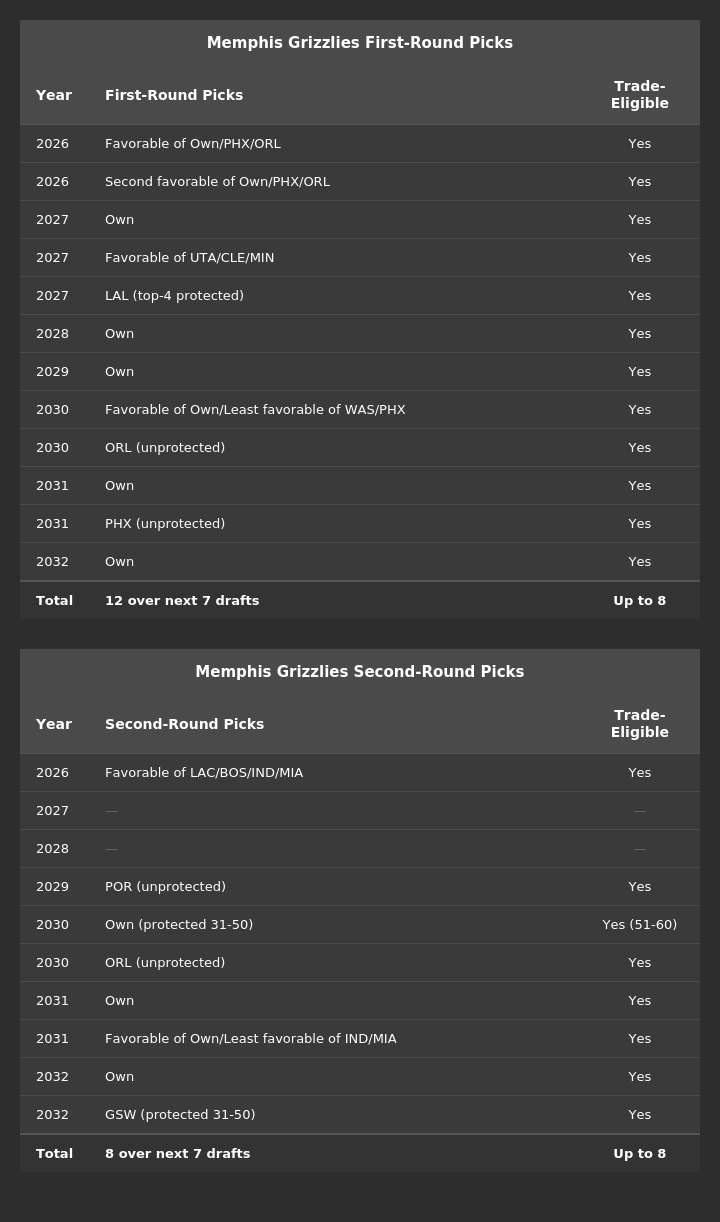
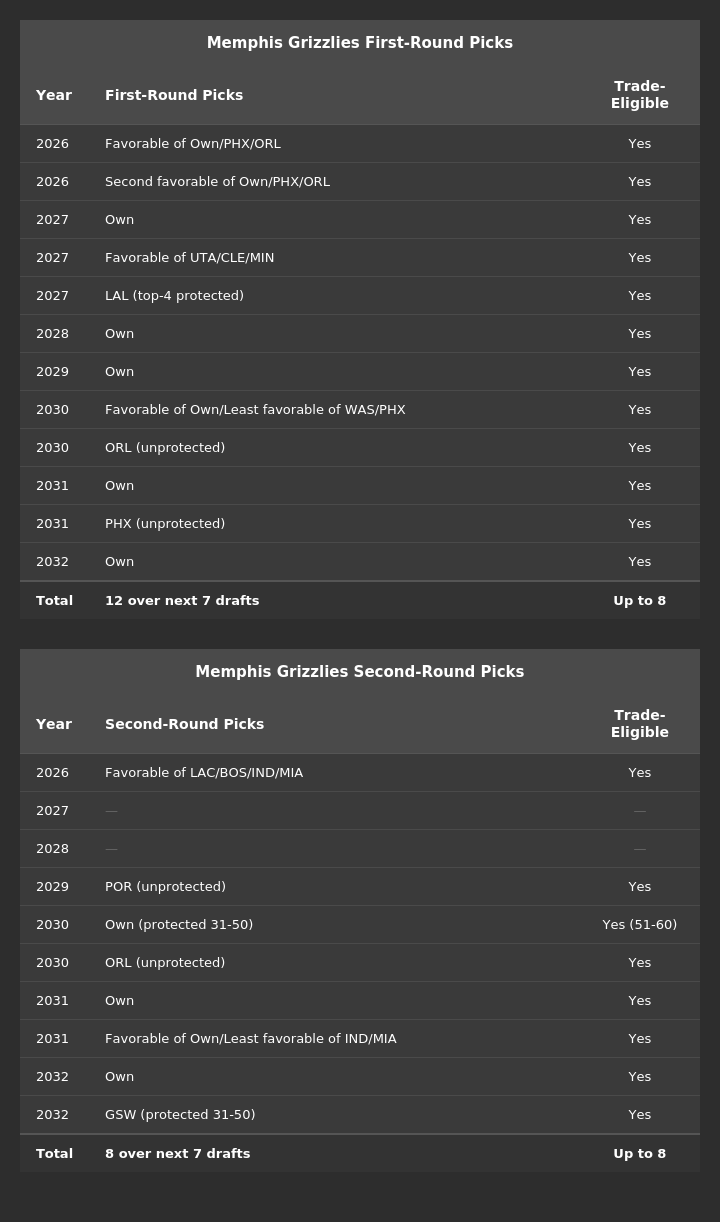
Draft Capital. The Grizzlies start their rebuild with a surplus of draft capital, and I suspect they’ll only add to this stockpile:
CHI-MIN-DET

Trade Mechanics
Chicago
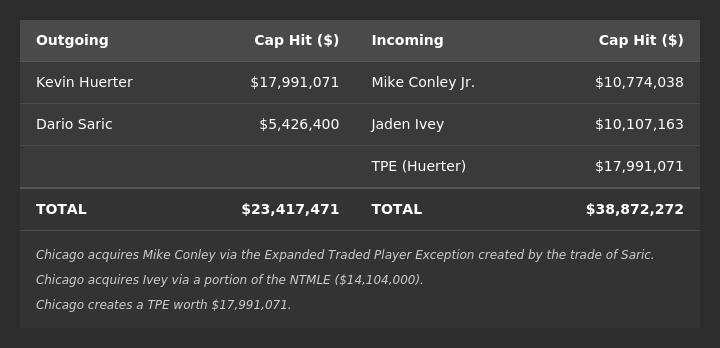
Chicago acquires Mike Conley ($10,774,038) via the Expanded Traded Player Exception created by the trade of Dario Saric ($5,426,400).
Chicago acquires Jaden Ivey ($10,107,163) via a portion of the Non-Taxpayer Mid-Level Exception ($14,104,000). Chicago has ~$4 million remaining of their NTMLE.
Chicago also creates a TPE worth $17,991,071, which will expire one year from the date the trade is finalized with the league office.
Minnesota
Minnesota sends out Mike Conley ($10,774,038) while taking back just cash considerations, creating a $10,774,038 TPE, which will expire one year from the date the trade is finalized with the league office.
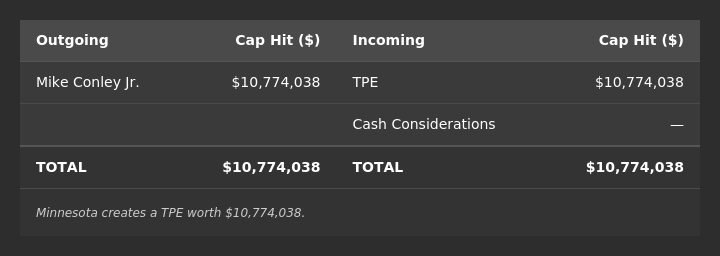
I have not seen it reported yet, but I suspect that the amount of cash Minnesota receives here is $1.1 million.
Detroit
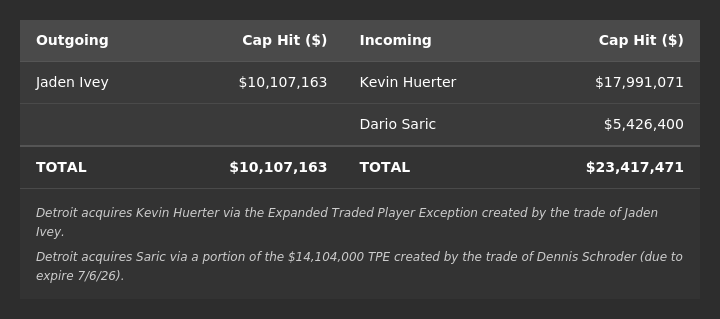
Detroit acquires Kevin Huerter ($17,991,071) via the Expanded Traded Player Exception created by the trade of Jaden Ivey ($10,107,163).
Detroit acquires Dario Saric ($5,426,400) via a portion of the $14,104,000 TPE created by the trade of Dennis Schroder (due to expire 7/6/26).
Detroit also receives a 2026 1st round protected swap (via MIN). I have not seen the protections on that pick swap reported, but I think it’s safe to say it’s something like lottery or top 20 protected.
Detroit also waives Isaac Jones to create the roster spot to take in the 2-for-1.
Strategic Implications
Chicago
This does not reflect the Vucevic for Simons trade yet; see below for that inclusion.
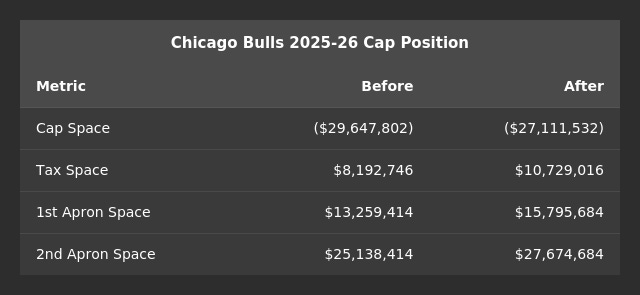
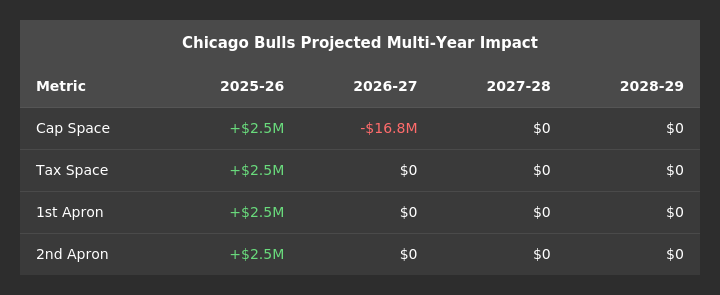
Jaden Ivey’s Impending Restricted Free Agency. I’m assuming Chicago does this deal with the intention of signing Ivey to a new deal this summer. They have plenty of financial flexibility and, personally, don’t think Ivey will have a particularly robust market. The question is really just the exact number they get to.
Mike Conley Buyout. The Bulls are reportedly working with him to find a destination before the deadline. If nothing materializes, a buyout is the likely outcome. Because Conley's salary falls below the Non-Taxpayer MLE threshold, he'd be able to sign with any team on the buyout market (other than the Wolves).
What do they do with all the guards? Ivey joins a guard rotation that already includes Josh Giddey, Coby White, Ayo Dosunmu, and Tre Jones (and, soon to be, Anfernee Simons). That's probably not sustainable. Expect at least one more move before the deadline to thin things out. White and Dosunmu are the most likely candidates to be shopped.
Minnesota
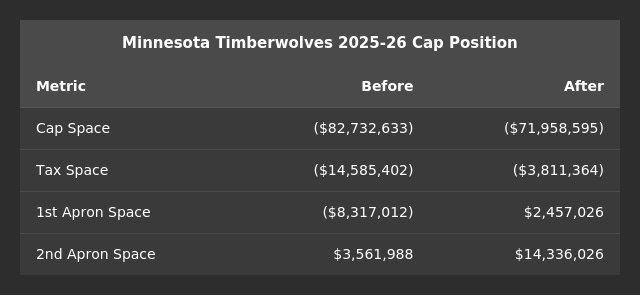
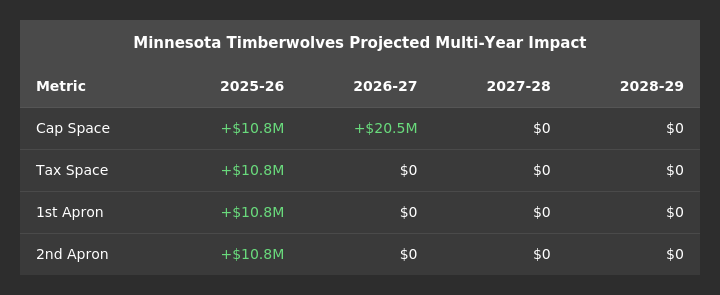
Minnesota got under the First Apron. The Wolves will be about $2.5 million under the First Apron. It’s not a huge buffer, but enough to restore meaningful flexibility. They can absorb a bit more salary in a trade now, and they don't have to worry about creeping toward the Second Apron.
Now what? A run at Giannis? A point guard acquisition? Something else? We'll see. But the Wolves are better positioned to execute whatever they have in mind than they were before this deal.
Why cash considerations? In any multi-team trade, each team must both send and receive at least one qualifying asset (a player contract, future draft pick that will convey, draft rights, or $1.1M in cash). Minnesota is giving Conley, but they have to get something, too. So, they get cash. And this is why I strongly suspect it is $1.1 million of it.
Detroit
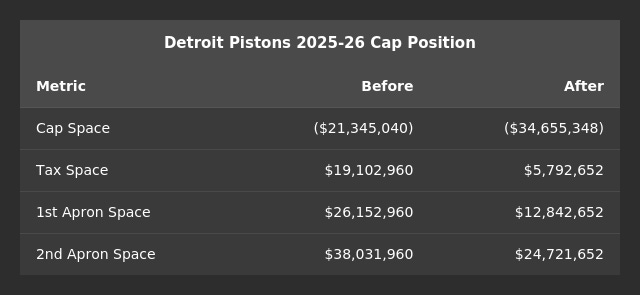
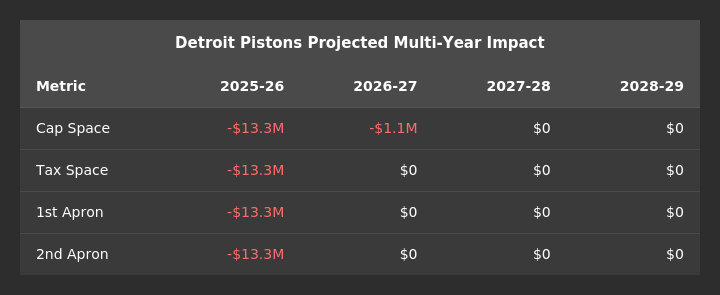
~$5.8 million in Tax Space. Detroit still has some room to play with as we head toward the deadline. Probably nothing major, but they can still make some margin moves while staying under the Tax (assuming that is a goal of theirs).
Adding shooting. I’m maybe a bit more bullish than others on Huerter’s ability to provide spacing for Detroit’s offense. Huerter's three-point numbers have dropped every year for three straight seasons now, but I really like the idea of him playing off of Jalen Duren. Maybe it works, maybe not. Worth a try.
Saric Buyout. Saric is unlikely to last on the roster. Detroit needs to open a spot for Daniss Jenkins (if they can come to a conversion agreement).
Moving on from Ivey. Ivey became the odd man out in a few ways in Detroit. For one, Detroit’s wing depth has only solidified with the play of Thompson, Holland, and Jenkins. For another, Detroit is likely planning to give Jalen Duren a pretty large contract this summer. It’s hard for Detroit to do that, while also planning enough room to pay others down the line, while paying Ivey. I file this one in the “it was just time” category, and is probably beneficial for both team and player.
Cap Space Plan. Detroit can open up roughly $30 million in cap room this summer by letting their free agents walk (aside from Jalen Duren) and declining their partial and non-guaranteed deals. Just something to monitor.
BOS-CHI

Trade Mechanics
Chicago
Chicago acquires Anfernee Simons ($27,678,571) via the Expanded Traded Player Exception created by the trade of Nikola Vucevic ($21,481,481).
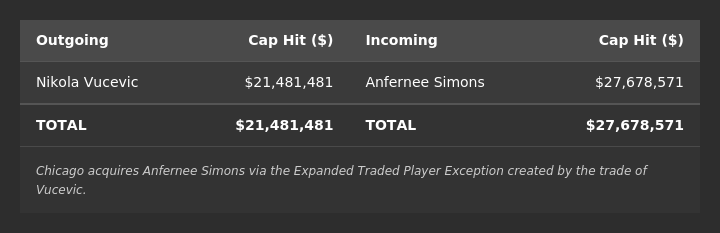
Chicago also receives the most favorable 2026 2nd round pick of MIN/NOP/NYK/POR.
Boston
Boston acquires Nikola Vucevic ($21,481,481) via a portion of the $22,531,707 TPE created by the trade of Kristaps Porzingis (due to expire 7/6/26).
Boston also creates a TPE worth $27,678,571, which will expire one year from the date the trade is finalized with the league office.
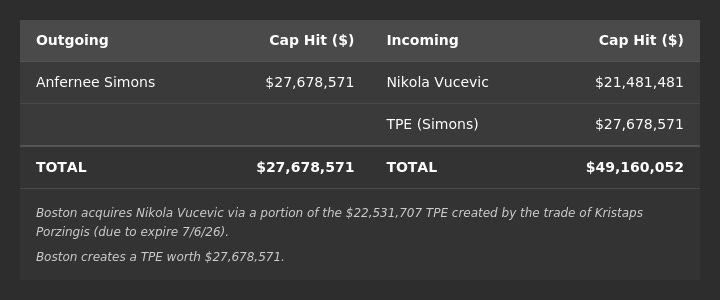
Boston also receives DEN’s 2027 2nd round pick.
Strategic Implications
Chicago
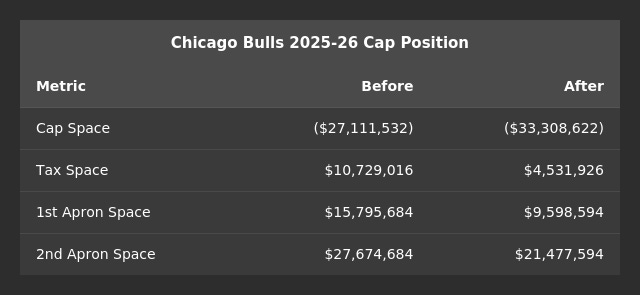
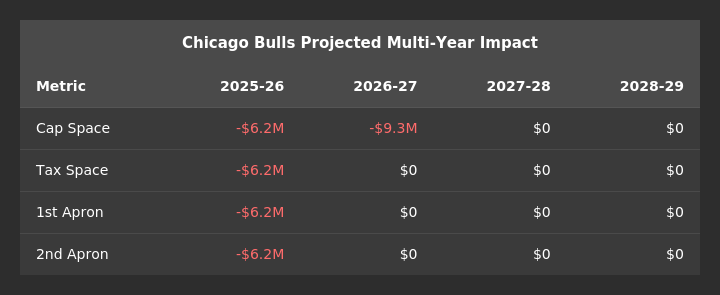
What to do with Simons? Simons is on an expiring contract, much like the rest of the Bulls’ roster. The biggest question here is whether the Bulls plan to keep Simons long-term and at what number? Generally, the market for smaller scoring guards has dried up recently, so I don’t anticipate a bidding war.
What to do with all the guards!? See the Chicago section above.
Gained value on the 2nd round pick. The best of MIN/NOP/NYK/POR 2nd is almost certainly more valuable than DEN’s 2027. This could very well be the entire point of the trade for Chicago, and they have little intention of retaining Simons. I really like this return for Chicago.
Boston
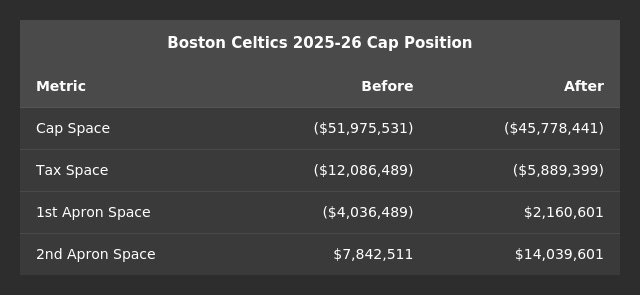
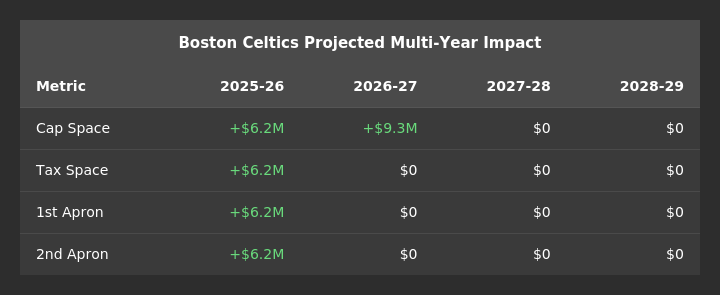
TPE fun. The Celtics used the Kristaps Porzingis TPE (worth $22.5M, set to expire in July) to absorb Vucevic's $21.5M salary, and then created a brand new $27.7M TPE from the Simons outgoing salary. That’s a pretty good way to address an immediate need while improving future flexibility. I’d bet that Boston pushes to use this TPE around draft time.
Under the First Apron. The Celtics moved from roughly $4 million over the line to about $2.2 million under it. This restores access to the MLE, allows salary aggregation in trades, and allows them to sign just about any buyout player out there (though, the buyout market is almost always overstated this time of year). All in all, they gain some flexibility should they choose to use it.
Tax Savings. Boston lessens its Tax bill by over $20 million. They inch closer and closer to the Tax line itself. I don’t necessarily anticipate them going fully under the Tax, though Sam Hauser is the likely candidate for trade if they do decide to go that route.
CLE-LAC

Trade Mechanics
Cleveland
Cleveland acquires James Harden ($39,182,693) via the Standard Traded Player Exception created by the trade of Darius Garland ($39,446,090).
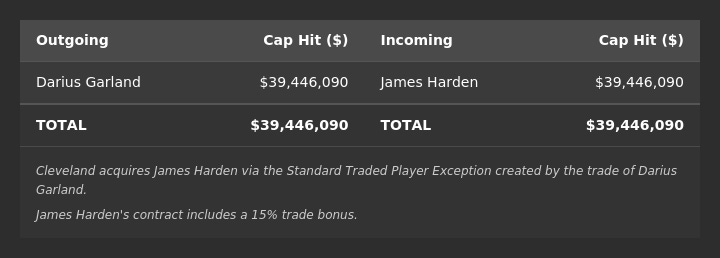
Note: Harden’s contract contains a 15% trade kick, which cannot exceed Darius Garland’s salary for matching purposes (given Cleveland’s position above Second Apron Level). So, we are assuming that Harden will only earn a trade bonus amount equal to the difference in the two players’ salaries.
LA
LA acquires Darius Garland ($39,446,090) via the Expanded Traded Player Exception created by the trade of James Harden ($39,182,693).
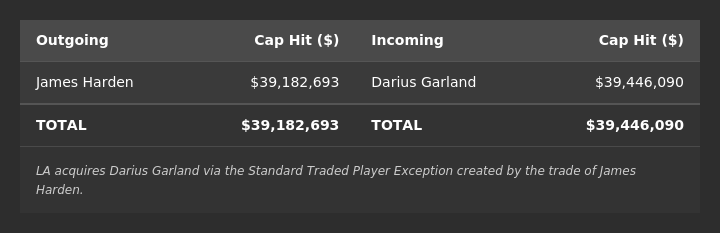
LA also acquires Cleveland’s 2026 2nd round pick.
Strategic Implications
Cleveland
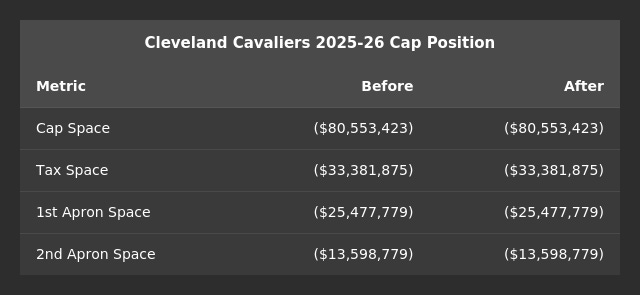
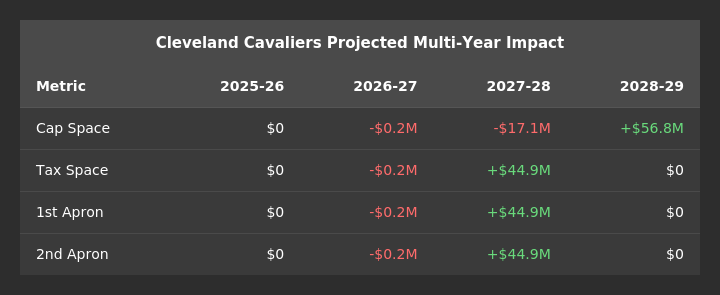
Getting under the Second Apron Level? The Cavs sit just $13.8 million above the Second Apron Level now, with expiring contracts such as Lonzo Ball and Dean Wade on the books. My best guess is that they try to get under this line in the next 24 hours.
Draft Capital. The Cavs are down to just two 2nd round picks eligible for trade after sending their 2026 to LAC in this deal. I often compare 2nd round picks to cigarettes in prison (I didn’t come up with this originally). They’re the currency in trade. It’s worth tracking for Cleveland.
James Harden’s next contract? I’d anticipate that there’s mutual interest in Harden opting out of his player option next summer to sign a longer-term deal with a lesser short-term cap hit. I’d also anticipate that the two sides already wink wink understand what those terms may generally be given that Harden waived his implied no-trade.
LA
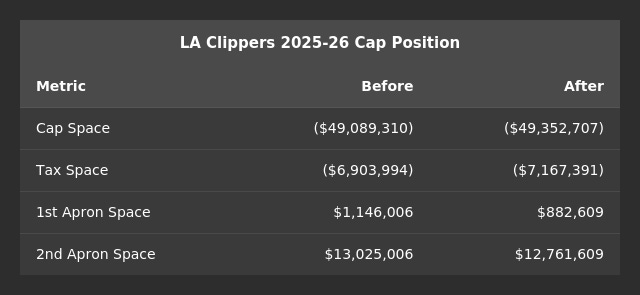
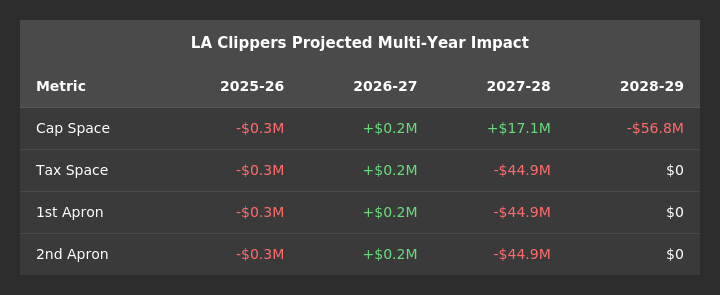
A little less flexibility. With the acquisition of Garland’s contract, the Clippers now have slightly less future financial flexibility. Note, the cap space differential number above includes cap holds and does not project maximum cap space. That said, the Clippers still have as much flexibility as anyone with just Zubac and Garland on the books as guaranteed money in 2027-28.
Garland extension eligibility. Garland will be eligible for an extension this summer for 3 years up to ~$178 million. This amount will increase to 4 years up to ~$246 million in the summer of 2027. It’s something to monitor, especially given Garland’s injury history. I don’t anticipate the Clippers being eager to extend just yet.
Love it!